
What Are the Rock-Like Microbialites on Antelope Island?
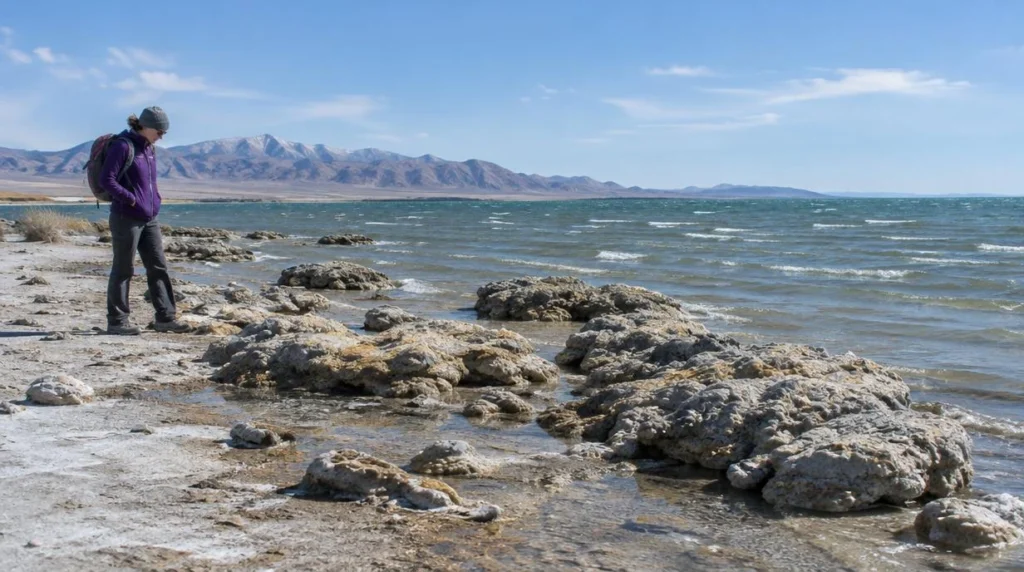
For a self-guided look at Antelope Island’s microbialites, my recommendation is to start at Ladyfinger Point beside Bridger Bay. It gives you a named parking point and a published location to plan around. The rock-like mounds you are looking for are carbonate structures built by communities of microscopic organisms. They are both a geological feature and part of Great Salt Lake’s food web.
Where to see microbialites: Ladyfinger Point
The Utah Geological Survey directs visitors to park at Ladyfinger Point. From the park entrance gate, continue across the Davis County Causeway for about 7 miles. On reaching the island, veer right, pass the marina and continue about 0.5 miles toward the Ladyfinger Point parking area beside Bridger Bay.
UGS gives GPS coordinates of 41° 03′ 29″ N, 112° 14′ 58″ W in its January 2022 guide. Use them as a reference for the Ladyfinger Point locality. The exposed shoreline and the visibility of living mats change with lake levels, so follow open shoreline access and posted restrictions when you arrive rather than treating the old low-water description as today’s conditions.
I would bring water and sun protection before leaving the car. The park’s Lady Finger Point factsheet lists vault restrooms and a shaded picnic pavilion, but no water supply and no shade on the trail or beach. The pavilion is a place for a break, not a reason to expect shade along the walk. Egg Island is a useful landmark in the view from the point. Keep it as a viewing landmark: the park closes Egg Island to access year-round to protect nesting birds.
How microbialites form
The builders are mainly cyanobacteria, along with algae and diatoms, which use sunlight to make food. Their mats build the structure in two ways. They trap and bind carbonate sediment, including small rounded grains called ooids, and they cause calcium carbonate to precipitate out of the salty water, adding solid mineral material. The Utah Geological Survey’s drought report describes both processes and explains why falling lake levels threaten microbialites.
What microbialites look like at Bridger Bay
Microbialites do not all look alike. Bridger Bay field mapping describes round or oval domes, low mounds that merge together and ring-shaped structures formed by collapse, with individual features ranging from centimeters to several meters across.
Living microbialites under water carry dark green, brown or black gelatinous mats, as a Salt Lake Tribune report describes, and look very different from bare shoreline rock. Surveys by the Utah Geological Survey record the densest Bridger Bay accumulations between 4,190 and 4,195 feet of lake elevation. When low water exposes them to air, the mats dry out and die back. According to a Standard-Examiner report, the structures then bleach white or gray, leaving knobby, porous rock. These pale formations may be easier to recognize as rock, but their color marks the loss of the living surface.
How these mounds support the lake’s food web
According to the Utah Geological Survey, microbialites and other microbial mats on the lakebed account for an estimated 30–50% of primary productivity in Great Salt Lake’s South Arm. Primary productivity is the production of organic matter at the base of a food web, so these mats produce a substantial share of the food that supports life in this part of the lake.
Beyond producing food, the communities fix nitrogen, cycle sulfur and store carbon. These processes, described in the scientific chapter Microbialites of Great Salt Lake, tie the living mats to the South Arm’s water chemistry.
Research on brine flies documents a direct connection between the mounds and the insects: brine fly larvae graze on the microbial film and use the hard carbonate structures as surfaces for pupation. That link extends to birds. According to the Utah Geological Survey, millions of shorebirds and waterfowl at Great Salt Lake feed heavily on brine flies and brine shrimp, and when microbialite mats dry out or die, the brine flies’ food base deteriorates. That weakens one link in the birds’ food supply. Our guide to Antelope Island’s brine flies covers the flies themselves, and our Antelope Island birdwatching guide covers where and when to watch the birds.
View them on foot and leave the structures intact
My priority here would be a clear look without using the formations as a path. UGS warns that these delicate structures can break under a person’s weight, so keep off the mounds as well as living mats, including pale, exposed microbialites. Continue on foot only where shoreline access is open. Off-road motorized vehicles are prohibited on exposed lakebeds and beaches. Check current Antelope Island State Park guidance for any access changes before setting out.
The Parks Pass FAQ lists a rule specific to Bridger Bay Beach: pets are prohibited there, except for trained service animals.
Leave every microbialite and fragment where it is, including the pale, dry pieces. Utah Administrative Code R651-620-2 prohibits removing, taking or damaging natural, geological or cultural resources in the park, and taking microbialite samples is illegal. The park’s questions and answers page explains that this protection applies throughout Antelope Island State Park.
Our Antelope Island day tour and sunset tour both include a 30-minute stop at Unique Sand Beach, but neither itinerary lists a microbialite stop. If seeing microbialites is the main purpose of your visit, I would plan the Ladyfinger Point stop separately. At every stop, natural and geological material stays where you find it.
 Secret Find!
Antelope Island – Wild Heart of the Great Salt Lake Adventure
from $120 · 6-7 hours · up to 13 persons
Promo code for this tour
10% OFF this tour
You found a hidden promo code! Use it at checkout.
Limited time offer. Book now and save!
 Should You Cancel a Utah Outdoor Day Because of Wildfire Smoke?
 When Should a Utah Park Day Trip From Salt Lake City Become an Overnight?
 Your First Evening in Salt Lake City: A Low-Pressure Orientation Plan
 Bonneville Salt Flats Photography Etiquette: How to Protect the Surface and Share the View
 How to Plan an Antelope Island Birdwatching Visit
 Why Are There So Many Brine Flies on Antelope Island?

Did the Antelope Island tour. This is run by a Ukrainian guy, perhaps as a one-person...
Read more →Guide was Great! The salt flats had alot of water due to recent rain which limited...
Read more →I booked the Bonneville Salt Flats tour w Matei bc the owners are Ukrainian. I’m so...
Read more →This experience is a must-do! Dima explains the history of the area as well as the...
Read more → Bonneville Salt Flats – Sunset Adventure of the White Desert
 Antelope Island – Wild Heart of the Great Salt Lake Adventure
 Antelope Island Sunset Wildlife Expedition – Great Salt Lake Odyssey
 Bonneville Salt Flats – Journey to the Edge of the World