
Utah Dark-Sky Etiquette: How to Visit Responsibly After Sunset
By Dima Mateiko, Founder of Matei Travel LLC
For an independent dark-sky outing in Utah, I would settle the viewing site and its parking before sunset. Pick a place where you are allowed to stay after dark, arrive in an established lot, and switch to a dim red light once you are safely parked. Those choices matter more than finding the darkest-looking pullout along the drive. If your chosen site is closed at the hour you want to be there, change the location or the timing instead of stopping on a road shoulder.
1. Match your viewing time to the site’s access rules
Start with the official page of whoever manages the site. Look there for opening hours, the time the entrance gate closes, any designated night viewpoints and whether parking is accessible after dark. Then check whether staying past day-use hours requires a camping reservation or joining an authorized event. Antelope Island and Bryce Canyon answer those questions in ways that lead to very different plans.
Antelope Island State Park lists hours of 6:00 a.m. to 10:00 p.m., so on a day visit, plan to finish viewing and leave by 10:00 p.m. Friends of Antelope Island explains that viewing after that time is limited to registered campers and sanctioned astronomy events, including star parties at White Rock Bay. If you are going as a camper or for an event, confirm those arrangements along with the park’s current hours before you set out.
The Ogden Astronomical Society describes the mainland entrance gate closing to inbound traffic at 10:00 p.m. After that, a motion sensor opens the outbound gate so vehicles can leave, but you cannot re-enter. For campers and event visitors staying late, driving out ends access for the night.
When a plan depends on viewing past 10:00 p.m., I would choose Bryce Canyon over a day visit to Antelope Island. Bryce is open 24 hours, and its viewpoint lots stay open to private vehicles after dark. Independent stargazing at its public rim overlooks needs no night-sky permit or reservation, according to the Dark Skies Atlas FAQ. The NPS night-sky guide names Sunset Point, Sunrise Point, Inspiration Point and Bryce Point as the primary rim overlooks for viewing, so pick one of them and plan to use its viewpoint lot.
2. Finish parking before switching off your lights
Park in an established lot. A narrow road shoulder adds roadside hazards and the risk of a collision with wildlife. At Bryce, follow the park’s parking guidance and keep your vehicle fully within a paved stall. Once you have stopped, do not sit idling with your headlights aimed into the viewing area.
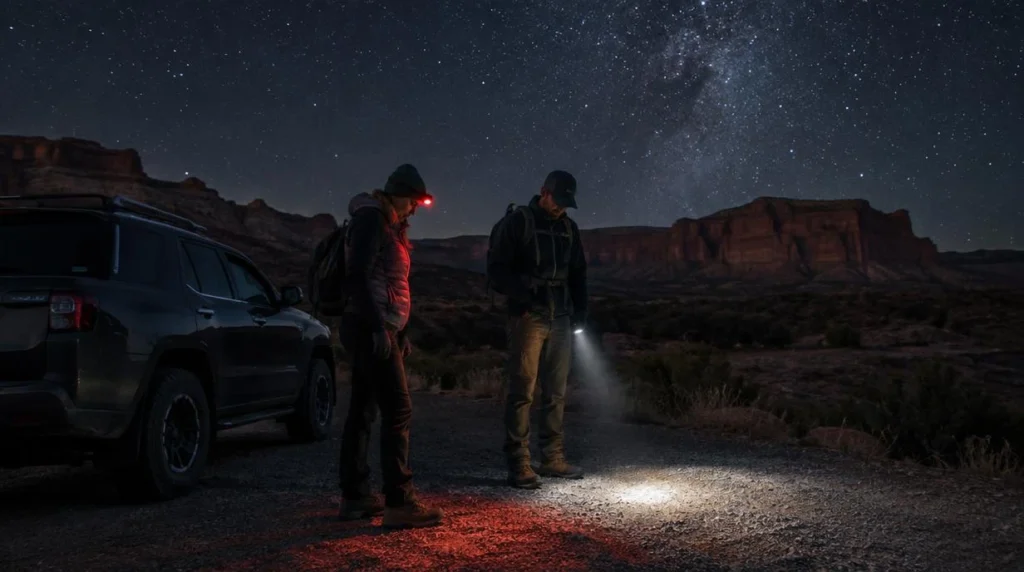
Where the layout lets you do it safely, park facing away from the people observing the sky, then switch off your headlights and interior cabin lights. The Ogden Astronomical Society sets out this arrival etiquette for Antelope Island, and it is just as considerate at any shared viewing area. Have your red light ready before you get out so you do not light up the gathering.
3. Give everyone’s eyes time to adapt
Allow 20–30 minutes in low light for your eyes to adapt. According to the NPS explanation of dark adaptation, seeing more of the night sky takes time in darkness, and NPS stargazing etiquette notes that white light from a flashlight, headlamp or phone undoes night-vision adaptation instantly. At the viewing area, use a dim red light aimed at the ground, or cover a regular flashlight with red cellophane or tape. Keep your phone put away, and if you need to make a call, go back to your vehicle.
4. Keep the shared space quiet and clear
Keep conversation low and leave car stereos and portable speakers off. Utah State University Extension’s Park After Dark guidance links quiet visits to protecting natural soundscapes and the behavior of nocturnal wildlife. It also flags a park-specific lighting rule: Arches and Canyonlands national parks prohibit using artificial light to illuminate natural landscape features, a practice known as light painting.
At a shared telescope area, NPS night-sky etiquette asks visitors to keep bags and loose gear away from tripods and walkways and to leave pets out of that space. People need a clear path between observing positions so they can move in the dark without stepping over your belongings.
 Before a Utah Day Trip: How to Check Weather, Roads, Park Alerts and Air Quality
 What Are the Rock-Like Microbialites on Antelope Island?
 Should You Cancel a Utah Outdoor Day Because of Wildfire Smoke?
 When Should a Utah Park Day Trip From Salt Lake City Become an Overnight?
 Your First Evening in Salt Lake City: A Low-Pressure Orientation Plan
 Bonneville Salt Flats Photography Etiquette: How to Protect the Surface and Share the View

Did the Antelope Island tour. This is run by a Ukrainian guy, perhaps as a one-person...
Read more →Guide was Great! The salt flats had alot of water due to recent rain which limited...
Read more →I booked the Bonneville Salt Flats tour w Matei bc the owners are Ukrainian. I’m so...
Read more →This experience is a must-do! Dima explains the history of the area as well as the...
Read more → Bonneville Salt Flats – Sunset Adventure of the White Desert
 Antelope Island – Wild Heart of the Great Salt Lake Adventure
 Antelope Island Sunset Wildlife Expedition – Great Salt Lake Odyssey
 Bonneville Salt Flats – Journey to the Edge of the World