
Two-Day Needles Backpacking Intros: Gear, Food, and Pace
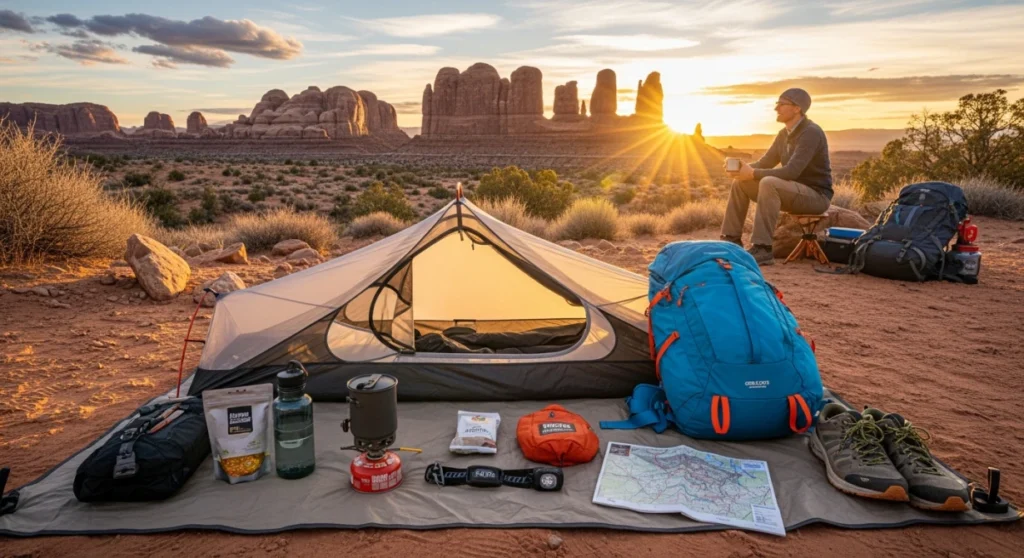
A first two-day Needles backpacking trip works best with a light, simple kit, easy food, carried water, and a conservative pace. Plan around primitive trails, required waste pack-out, and any route-specific food storage rules.
The most common first-timer mistake in the Needles is packing for a casual overnight and then discovering the route feels far more serious once the trail turns primitive, the cairns spread out, and the water you hoped to find is not there. That mismatch matters because this part of Canyonlands asks for backcountry judgment even on a short trip.
For a two-day introductory outing, the winning approach is simple but not easy. Keep the load disciplined, carry the water you truly need, choose food that works without fuss, and set a pace that still leaves room for navigation, steep passes, ladders, and camp chores.
What does a two-day introductory backpacking trip in the Needles look like in real practice?
A two-day intro here is not a “quick overnight” in the casual sense. It is a short backcountry trip that still requires self-sufficiency, careful pacing, and a realistic plan for water, waste, and routefinding.
In practice, this kind of outing works best for travelers who want a first backpacking experience with structure and support, including a two-day guided backpacking intro into Needles District with food and gear rental or a similar arrangement that removes guesswork from the basics. The short duration helps, but the terrain still demands attention because trails can be primitive and marked mainly by cairns.
The Needles also differs from easier frontcountry hiking because water sources are scarce and unreliable. That single fact changes almost every decision. It affects pack weight, food choice, cooking style, turnaround time, and how far you should realistically plan to travel in one day.
| Trip element | What it means in the Needles | Practical implication |
|---|---|---|
| Water | Scarce and unreliable | Plan to carry what you need instead of expecting to refill |
| Trail character | Marked with cairns, often primitive | Build in time for navigation and slower movement |
| Terrain features | May include steep passes, narrow spots, drop-offs, or ladders | Choose a conservative daily distance for a first trip |
| Backcountry sanitation | Solid human waste must be packed out | Bring commercial disposal bags and know how to use them |
Backpackers in this district must carry out all solid human waste using commercial human waste disposal bags.
Backcountry requirement
Where do people misread the difficulty, and why does that lead to bad gear and food choices?
Most misjudgments come from assuming two days means low commitment. In this terrain, a short schedule does not reduce the need for solid footwear, disciplined packing, or a food plan that works when you are tired and dry.
People often underrate how much routefinding and careful foot placement slow a group down. A trail marked by cairns can still feel vague, especially when the path crosses rock or breaks into steeper sections. When that happens, extra clothing, extra luxury items, and overcomplicated meals stop feeling harmless and start feeling heavy.
Another frequent mistake is treating water like a backup problem instead of the main planning constraint. On a weekend in greener country, you might get away with carrying less and filtering along the way. In the Needles, that assumption can wreck the trip before camp is even set.
Food gets misread too. Beginners often pack either too little usable energy or too much bulky food that requires time, cleanup, and water they cannot spare. Intro trips go better when meals are simple, familiar, and quick to eat, especially after a slow afternoon on primitive trail.
- Misread: “It is only one night.” Short duration does not change the need to carry essentials and move carefully.
- Misread: “I will probably find water.” In this district, water should be treated as uncertain, not assumed.
- Misread: “A few extra comfort items will not matter.” Extra ounces matter more when ladders, narrow passages, and steep sections appear.
- Misread: “Camp food should feel special.” The better test is whether it is easy to prepare and easy to finish when everyone is tired.
What gear actually matters most for a first two-day trip here?
The priority gear is the gear that protects movement, hydration, camp basics, and required waste handling. For an introductory trip, leave specialty extras behind and focus on a lighter, simpler kit you can manage confidently.
Your carrying system matters because water can be the heaviest part of the load. A pack that rides well when full is more useful than a minimalist setup that becomes uncomfortable once the water weight goes in. If food and gear rental are included through a guided outing, use that advantage to avoid bringing duplicate items from home.
Footwear deserves more attention than beginners usually give it. Primitive routes, rocky surfaces, and occasional ladders reward shoes or boots you already trust. The point is not stiffness for its own sake. The point is stable movement when the trail gets narrow or uneven.
Navigation tools should be treated as active equipment, not dead weight. Cairns help, but they do not remove the need to stay oriented, especially when the line of travel is less obvious across rock.
| Gear priority | High priority | Can stay minimal |
|---|---|---|
| Water carrying capacity | Yes, essential | No |
| Reliable footwear | Yes, essential | No |
| Navigation readiness | Yes, essential | No |
| Camp luxury items | No | Yes, keep limited |
| Complex cooking setup | No | Yes, simplify |
| Waste disposal bags | Yes, required | No |
Practical gear checks before you leave the trailhead
- Pack test: Walk with your fully loaded pack before the trip, including the water you expect to carry.
- Footwear check: Use broken-in shoes or boots with good grip, not a brand-new pair.
- Navigation check: Make sure everyone understands that cairns guide the route but do not make it foolproof.
- Waste check: Confirm each person has access to commercial human waste disposal bags.
- Redundancy check: If rental gear is provided, do not bring overlapping items “just in case” unless they solve a real problem.
How should you plan food for one night without overpacking?
Food for this trip should be compact, familiar, and easy to eat with little water and little cleanup. The best menu is rarely the most ambitious one. It is the one your group will actually want after a hot, slower-than-expected day.
For one night, think in terms of reliable fuel rather than variety for its own sake. Lunch and trail snacks should be accessible while moving. Dinner should be easy to portion and straightforward to prepare. Breakfast should be quick enough that you do not lose the morning to camp chores.
Salt Creek Canyon adds one very specific requirement during part of the year. From March 15 through November 30, all food and scented items there must be stored in hard-sided, park-approved animal-resistant containers. If your route includes that area in that season, the container is not optional.
| Food planning choice | Better for a first trip | Why it works |
|---|---|---|
| Simple dinner | Yes | Less time, less cleanup, less stress at camp |
| Grab-and-go snacks | Yes | Easier to keep energy up on slow trail sections |
| Bulky fresh food | Usually no | Adds weight and spoilage risk without much payoff |
| Multi-step meals | Usually no | Consumes time and often needs more water |
| Animal-resistant container in Salt Creek Canyon, Mar 15 to Nov 30 | Required | Applies to all food and scented items in that area during that window |
Three food rules that help beginners immediately
- Pack what you already tolerate well: A first backcountry night is not the time to experiment with unfamiliar meals.
- Front-load convenience: Keep the first day’s lunch and snacks easy to reach so the group eats before anyone gets drained.
- Match dinner to fatigue: Choose a meal you can prepare even if arrival is later and everyone is tired.
You found a hidden promo code!
Use code WOWBLOG at checkout and get 10% OFF any tour!
Limited time offer. Book now and save!
Browse ToursWhat pace is realistic for beginners on a two-day Needles itinerary?
A realistic pace is slower than most first-timers expect, because routefinding, terrain features, and water weight all add friction. For beginners, the right speed is the one that preserves balance, decision-making, and camp setup time.
Do not judge the day only by mileage. Steep passes, narrow spots, drop-offs, and ladders can change how long a section takes and how mentally tiring it feels. A calm, steady pace usually beats a fast start followed by a sloppy final hour.
One useful rule is to protect the afternoon. If your group arrives in camp with enough energy to set up, eat, and handle required waste procedures without rushing, the pace was probably appropriate. If camp tasks feel frantic, the day was too ambitious.
Key: signs your pace is too fast
- Navigation drops off: People stop noticing cairns and rely on the person in front.
- Snack and water breaks disappear: The group starts “pushing through” instead of maintaining energy.
- Foot placement gets sloppy: Stumbles and hesitation increase on rocky or narrow terrain.
- Camp timing gets compressed: You reach camp too drained to organize food and gear efficiently.
How do practical decision scenarios change the right gear, food, and pace?
The right setup depends less on abstract backpacking theory and more on the exact trip conditions. The smartest choices come from matching your plan to season, route area, and the experience level of the group.
Scenario 1: You are joining a guided overnight where food and gear rental are included. In that case, your best move is to bring only personal essentials, worn-in footwear, and clothing suited to current conditions. The trip goes better when you let the provided setup reduce complexity instead of layering your own extras on top.
Likely outcome: A lighter pack, quicker camp routine, and fewer beginner errors tied to duplicate gear or unrealistic meal plans.
Scenario 2: Your route includes Salt Creek Canyon between March 15 and November 30. That changes storage planning immediately because food and scented items must go in hard-sided, park-approved animal-resistant containers. If your normal overnight habit is to pack loosely, this is where that habit stops working.
Likely outcome: Better compliance and a more organized camp, but also a need to pre-pack food so it fits the required container efficiently.
Scenario 3: You are comparing this overnight idea with easier sightseeing options such as Utah day tours, canyonlands tours from Moab, or broader Utah national parks tours from Salt Lake City. If your group is unsure about carrying water, routefinding on primitive trail, or handling backcountry waste requirements, a day-based format may be the better first step.
Likely outcome: Lower logistical stress and a clearer sense of whether a backpacking night is the right next move.

What mistakes show up most often on first Needles overnights, and how do you prevent them?
The big mistakes are predictable: overpacking, underestimating water needs, setting a frontcountry pace, and ignoring the specific storage and waste rules that apply. Prevention is mostly about disciplined planning before you start walking.
Overpacking usually comes from fear rather than need. Beginners add backup clothing, extra cookware, and camp comfort items because each item seems minor on its own. The fix is to ask a harder question for every item: will this materially improve safety, hydration, or recovery on this terrain?
Underestimating the route is another repeat problem. Primitive trails can be fun and beautiful, but they are not the place to learn through rushing. A conservative schedule gives the group time for route checks, steady hydration, and safer movement through narrow or exposed-feeling sections.
- Mistake: Packing food by appetite at home instead of appetite after a dry, demanding day. Prevention: Favor calorie-dense, easy-to-finish foods.
- Mistake: Assuming all canyons have the same food storage rules. Prevention: Check whether Salt Creek Canyon is part of your route and season.
- Mistake: Treating cairns as a guarantee against route errors. Prevention: Move slowly enough to keep the route obvious.
- Mistake: Forgetting waste disposal bags until the last minute. Prevention: Make them part of the mandatory pre-trip check, not an optional add-on.
What should your priority checklist look like before booking or heading out?
The best checklist starts with the non-negotiables: water, route realism, required waste handling, and any area-specific food storage rule. Once those are set, the rest becomes much easier to manage.
- Confirm the trip format: Decide whether you want a supported overnight with rental gear and food included or a self-managed outing.
- Set a conservative route plan: Assume slower travel than on a normal day hike because of terrain and navigation.
- Plan all water as carried water: Treat natural sources as unreliable for trip planning purposes.
- Build a simple menu: Choose compact, familiar items that require little cleanup.
- Check area-specific storage rules: If you will be in Salt Creek Canyon from March 15 to November 30, use hard-sided, park-approved animal-resistant containers for food and scented items.
- Pack required sanitation supplies: Bring commercial human waste disposal bags for everyone in the group.
- Do a full load test: Walk with your actual pack weight before travel day.
A short overnight in this district can be one of the best tours of Utah national parks for travelers who want more than a viewpoint stop, but only if the basics are handled with backcountry seriousness. The practical win is not hero mileage. It is finishing the trip feeling competent, not cooked.
If you want the cleanest first experience, keep the system simple. Lighten the load where you can, carry the water you truly need, keep food easy, and let the terrain set the pace instead of your ego.
That is the difference between a tough but satisfying intro and a weekend that feels harder than it needed to. MateiTravel can help if you want a structured Utah backcountry introduction with fewer logistical unknowns.
Is a two-day Needles trip suitable for a first backpacking night?
Yes, if you treat it as real backcountry travel rather than a casual overnight. The short schedule helps, but primitive trails and limited water still require careful planning.
Can I count on finding water along the way?
No. Water sources in this area are scarce and unreliable, so your plan should assume you are carrying what you need.
Do I need special waste supplies for this trip?
Yes. Solid human waste must be packed out using commercial disposal bags.
When are animal-resistant containers required?
They are required in Salt Creek Canyon from March 15 through November 30 for all food and scented items. That rule is specific to that area and time period.
Why does pace matter so much on a short route?
Because ladders, steep passes, narrow sections, and routefinding can slow a group more than expected. A steady pace protects energy for camp tasks and safer movement.
Should beginners bring extra comfort gear just in case?
Usually no. On this kind of overnight, extra items often create more strain than benefit once water weight is added.
How is a guided intro different from a self-managed overnight?
A guided intro can simplify the basics when food and rental gear are included. That lets beginners focus more on walking, pacing, and backcountry habits.
 Antelope Island Day Tour or Sunset Wildlife Tour: Which Fits Your Salt Lake City Schedule?
 How to Dress for Changing Weather on Antelope Island
 How to Photograph People at Bonneville Salt Flats at Sunset
 How to Dress for Wind and Glare at Bonneville Salt Flats
 What a Guide-Led Utah Day Tour Handles for You
 Why Wildlife Sightings Cannot Be Guaranteed on Antelope Island

The tour was great and beautiful. Dima, the tour guide, explained everything clearly and had some...
Read more →What a beautiful experience! The drive is about 2 hours one way with interesting scenery the...
Read more →(From North Carolina on a business trip) '+ 'HANDS DOWN the best tour/guide I’ve ever had. And...
Read more →Went to Antelope Island. Terrible. Tour guide didn\'t do what he said he was going to...
Read more → Antelope Island – Wild Heart of the Great Salt Lake Adventure
 Antelope Island Sunset Wildlife Expedition – Great Salt Lake Odyssey
 Bonneville Salt Flats – Sunset Adventure of the White Desert
 Bonneville Salt Flats – Journey to the Edge of the World