
Teen Beginner Climbing in Arches: Safety Questions Parents Ask
May 2, 2026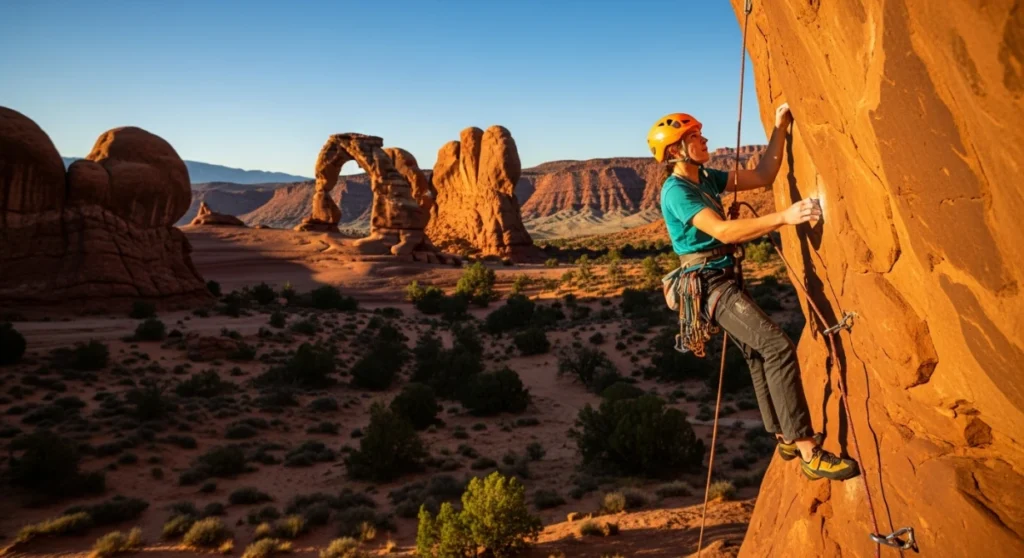
For teen beginners in Arches, the safest plan is a tightly supervised, low-ambition day with clear stop rules. Parents should judge readiness by focus, communication, and energy, not excitement or gym confidence.
Parents often focus on whether a teen is brave enough to climb, when the bigger issue is whether the adults around that teen are filtering risk well. In Arches, beginners can look calm on the ground, then freeze once height, heat, exposure, and unfamiliar rock all show up at once.
That matters because families planning an outdoor trip to Utah often try to fit a lot into a short window, and rushed decisions are where preventable mistakes happen. If your teenager wants a first climbing experience here, the safest approach is to treat the day as a supervised skills session with tight limits, not as a test of courage.
What parents usually notice first, and why it changes the whole day
The first warning signs are rarely dramatic. They usually show up as hesitation with gear, poor attention during instruction, overconfidence from gym experience, or fatigue before the climbing even starts.
For families, the impact is simple. A day that was supposed to build confidence can turn into panic, arguments, or an early retreat, and that is before you account for heat, long approaches, and the pressure of being in a famous park setting.
- Common early symptom: Your teen answers safety questions vaguely or looks to someone else before every step.
- Meaning: They are not yet owning the process, which is a bigger concern than raw strength.
- Parent impact: You spend the day guessing whether the situation is under control instead of enjoying it.
- Safety impact: Small setup errors become more likely when attention is split.
For a first day outdoors, calm decision-making matters more than performance. A teen does not need a bigger challenge. They need a smaller margin for error.
General climbing safety principle
The mistakes families repeat with teen beginners in Arches
Most problems come from treating outdoor climbing like a scenic add-on. Arches is not the place to improvise a first experience, especially when a teen is excited and parents are trying to judge risk from the sidelines.
Mistake 1: Assuming gym confidence equals outdoor readiness
Indoor skill can help, but it does not automatically transfer to natural rock, changing surfaces, exposure, or the mental load of a real outdoor setting. Teens who looked solid in a controlled space may hesitate when anchors, movement choices, and environmental distractions are less predictable.
Mistake 2: Choosing the day around sightseeing goals instead of energy and focus
Families often stack viewpoints, short hikes, photos, and then try to climb when everyone is already hot or mentally spent. That is when attention drops, instructions get rushed, and simple checks are skipped.
Mistake 3: Letting the teen set the challenge level
Motivated beginners often want something that looks impressive. Parents then feel caught between encouraging independence and pulling the plug, which creates pressure to continue after the day has clearly drifted past a safe learning pace.
Mistake 4: Treating gear as the main safety answer
Equipment matters, but parents often overestimate what gear can fix. A well-equipped teen is still unsafe if nobody is controlling pace, verifying understanding, and stopping the session when judgment fades.
| Situation | What parents often assume | What actually matters more |
|---|---|---|
| Teen has climbed indoors before | They are ready for outdoor beginner routes | How they handle instruction, exposure, and decision-making outside |
| Family has limited time in the park | Climbing can fit after other activities | Whether the teen starts fresh, hydrated, and focused |
| Teen wants a bigger challenge | Motivation means readiness | Whether they can follow a conservative plan without pushing limits |
| Gear looks complete | The major risks are covered | Supervision quality, checks, and stop criteria |
You found a hidden promo code!
Use code WOWBLOG at checkout and get 10% OFF any tour!
Limited time offer. Book now and save!
Browse ToursHow to fix the most important mistakes: mistake, cause, correction
The practical fix is to simplify the day until the safety decisions are obvious. Parents do better when they judge readiness through behavior and boundaries, not enthusiasm.
Fix pattern for mistake 1
Mistake: Using gym experience as proof that outdoor climbing is already familiar. Cause: Indoor repetition can hide how much teens rely on controlled conditions. Correction: Start with a beginner session where the goal is learning outdoor movement, commands, and pace. If you are considering an Arches beginner rock climbing lesson focused on gear and safety for teens, ask whether the plan emphasizes instruction and conservative route choice over mileage or photo moments.
Fix pattern for mistake 2
Mistake: Scheduling climbing after a full sightseeing morning. Cause: Families underestimate how quickly travel, walking, and sun drain attention. Correction: Put the skills activity first, or give it its own day. If the family mainly wants scenery with light walking, a guided sightseeing option can be a better fit than forcing a tired teen into a technical activity.
Fix pattern for mistake 3
Mistake: Negotiating challenge level in the moment. Cause: Parents do not want to discourage a capable teen. Correction: Set limits before anyone leaves the parking area. Agree that the adult or qualified instructor decides when to stop, repeat, or scale down.
Fix pattern for mistake 4
Mistake: Focusing on gear lists while ignoring communication. Cause: Tangible items feel easier to verify than judgment. Correction: Require the teen to explain the plan back in plain language. If they cannot describe the next step, the session is too complex or moving too fast.
- Best correction signal: Your teen can repeat safety instructions clearly without prompting.
- Stop signal: They become quiet, rushed, defensive, or start skipping small checks.
- Good parent question: “What happens next, and who confirms it?”
- Poor parent question: “Are you sure you’re fine?” because many teens will say yes just to keep going.
What a safer first climbing day should look like
A good first day is intentionally modest. It should feel a little slow, a little repetitive, and much less dramatic than your teen imagined.
- Start with clear authority. One adult or qualified instructor makes the final call on pace, repetition, and stopping.
- Keep the objective narrow. The win is learning safe habits outdoors, not doing the biggest route available.
- Protect attention early. Do not stack the session on top of a tiring park itinerary.
- Use teach-back checks. Have the teen explain commands, clipping sequence, and what to do if they feel stuck.
- End before focus drops. Confidence grows faster when the day stops while things are still controlled.
This is also where parents should stay honest about fit. Some teens are ready for supervised outdoor instruction, while others will have a better trip starting with hikes, viewpoints, and guided park context before trying technical activities on another visit.
Practical recommendations parents can use right away
These are the actions that tend to prevent the most trouble. None of them require advanced climbing knowledge, only disciplined decision-making.
- Ask for the day plan in simple language: You should understand the pace, walking load, and when the hardest part happens.
- Separate excitement from readiness: A teen who is eager but distracted is less prepared than a quieter teen who listens carefully.
- Watch the first ten minutes closely: That is when you see whether instructions are landing or just being nodded through.
- Set a no-argument stop rule: If fatigue, fear, or poor attention appears, the day scales down immediately.
- Bring a backup family plan: If conditions or readiness do not line up, switch to a non-technical park day instead of forcing the activity.
When a guided park day is the smarter choice than a climbing day
If your family wants to see a lot of Utah without managing every detail, a park tour can reduce the decision load that often leads to rushed outdoor choices. That is especially useful when parents are balancing teens, limited time, parking, trailheads, and long drives in unfamiliar areas.
Families looking at the Utah National Parks Tours often choose them because transport, key stops, schedule, and walking level are laid out in advance. For some parents, the best tours of Utah national parks are the ones that leave technical risk out of the day and let a guide handle logistics and context.
| Family goal | Better fit | Why |
|---|---|---|
| Teen wants a first technical outdoor skill session | Short, tightly supervised beginner instruction | The day can stay focused on learning and stop early if attention fades |
| Family wants scenery, photos, and low planning stress | Guided parks tour with light to moderate walking | Transport, viewpoints, and pacing are handled for you |
| Parents are unsure how teen will react to exposure | Non-technical park day first | You learn their comfort level without adding rope-system decisions |
| Trip schedule is already packed | Choose one main objective per day | Mixing too much into one day is where judgment slips |

Prevention protocol for future trips and repeat sessions
The safest families build a repeatable routine instead of deciding everything on the fly. A short pre-trip protocol can prevent most avoidable judgment errors.
- Screen the goal: Decide whether the day is for learning, sightseeing, or both. If it is both, reduce ambition.
- Screen the teen: Ask them to explain what they expect the day to feel like, not just what they want to do.
- Screen the schedule: Remove competing activities that drain energy before the technical part starts.
- Screen authority: Make sure one person has the final safety call and everyone agrees to that before the outing.
- Screen the exit: Know what the backup plan is if the teen is uneasy, tired, or not processing instruction well.
That same prevention mindset helps across a Utah trip. When families use organized outings for city walks or park days, the advantage is often not just convenience. It is having a clear structure, a smaller group, and room to ask questions before small problems turn into poor decisions.
Two realistic parent scenarios
Scenario one: A teen has gym experience, is enthusiastic, and wants an impressive outdoor first day. The parent notices the teen cannot explain the sequence of checks without help, so the plan is reduced to a supervised beginner session with repeated basics. The outcome is less exciting on paper, but the teen finishes calm and wants to come back.
Scenario two: A family is already doing viewpoints and short hikes, and the teen suddenly says they also want to climb that afternoon. Everyone is warm, hungry, and watching the clock. The parent says no, shifts to a lower-risk park activity, and saves technical instruction for another day when attention and energy are better.
Quick self-diagnosis checklist for parents
If you answer “no” to more than one of these, it is a signal to scale down or skip the climbing plan.
- Understanding: Can my teen explain the basic safety flow in their own words?
- Focus: Are they listening carefully, or just eager to get moving?
- Energy: Are they starting fresh rather than after a long sightseeing block?
- Authority: Is it clear who decides to stop or simplify the session?
- Backup plan: If this does not feel right, do we have a good alternative for the day?
- Expectation match: Are we treating this as instruction, not as a performance moment?
Conclusion
Teen beginners in Arches usually do best when the day is small, supervised, and built around attention rather than ambition. The most common family mistakes are overestimating transferable skill, piling too much into one day, and letting excitement set the risk level. If you judge readiness by communication, focus, and clear stop rules, you protect both safety and confidence. If your family wants a lower-stress Utah day while you sort out what your teen is truly ready for, MateiTravel can be a practical guided option.
Is gym climbing enough preparation for a teen’s first outdoor day in Arches?
It helps, but it does not prove outdoor readiness. Watch how your teen handles instruction, exposure, and changing conditions before assuming they are prepared.
What is the biggest mistake parents make with beginner climbing days?
They often combine too many activities and start the technical part after everyone is already tired. A fresh start gives you better attention and safer decisions.
How can a parent tell if a teen is not really ready that day?
If they cannot explain the next step clearly, seem rushed, or become unusually quiet, scale down. Behavior is a better signal than confidence talk.
Should parents let teens choose the difficulty of the climb?
No. A parent or qualified instructor should make the final call so the day stays conservative and does not turn into a pressure test.
When is a guided park tour a better option than climbing?
If your family wants scenery, easier logistics, and less decision strain, a guided parks day can fit better. It is also smart when you are unsure how your teen will react to exposure or fatigue.
What should parents ask before agreeing to a beginner session?
Ask how the day is paced, what the walking load is, and who controls stop decisions. You want a skills-focused plan, not an impressive-looking itinerary.

 Bonneville Salt Flats – Sunset Adventure of the White Desert
 Bonneville Salt Flats – Journey to the Edge of the World
 Antelope Island – Wild Heart of the Great Salt Lake Adventure
 Antelope Island Sunset Wildlife Expedition – Great Salt Lake Odyssey
 Salt Lake City – The City of Zion. Historical Interactive Walking Tour