
Arches Sunset Elopements: Permits, Photographer Rules, and Timing
May 22, 2026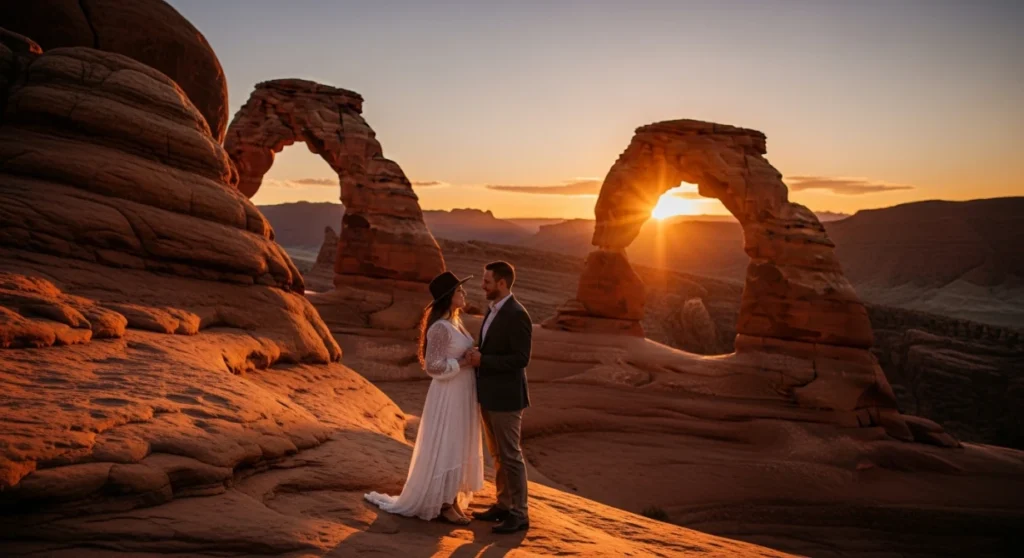
Arches sunset elopements are doable, but you need a Special Use Permit, a designated ceremony site, and a timeline built backward from real sunset light and park logistics.
Most Arches elopement problems start the same way. A couple sees a gorgeous sunset photo, assumes they can show up with a photographer and a vow book, and only later learns that a ceremony in the park is a regulated event with designated locations, group limits, and timing constraints that get tighter near sunset.
An Arches sunset elopement sits at the intersection of park rules, desert light, and road logistics. For couples deciding whether a simple ceremony in red rock country is worth the planning, the right question is not just “Is it beautiful?” but “Can we do it legally and without turning the evening into a rush?”
If you are trying to piece together a romantic sunset elopement package in Arches with photographer and permit coordination, the practical answer is that the ceremony itself still runs through National Park Service rules and the permit must be in the couple’s name. Where we help is on the travel side, especially for visitors building a larger Utah trip and wanting guided scouting, route planning, and a smoother park experience before or after the vows.
Is an Arches sunset elopement right for you and your guests?
Yes, if you want dramatic scenery and can accept real park constraints such as heat, walking, parking pressure, and limited ceremony sites. No, if you need guaranteed privacy, a completely flexible ceremony location, or an easy-access event for a large guest group with minimal walking.
Sunset is popular for a reason. Late-day light tends to flatter the red rock, and the hour before sunset often looks better in photos than the exact minute the sun drops. But popularity also means busier viewpoints, tighter parking, and more pressure to arrive early instead of floating in at the last minute.
This setting works best for couples who are comfortable with a simple event footprint. Even when the ceremony is small, the evening still depends on realistic pacing in wedding clothes, readiness for warm conditions, and a willingness to plan around the park rather than treat it like a private venue.
- Good fit: You want a small ceremony, can keep expectations flexible, and do not mind some walking to reach a viewpoint.
- Less ideal: You want seclusion at a famous location right at peak sunset, or you are inviting guests who need a highly accessible, low-effort setup.
- Good fit: You are open to holding the ceremony a bit before the posted sunset time, then using the best late light for portraits.
- Less ideal: You are flying into Salt Lake City and planning to self-drive long hours on the same day as the ceremony without a buffer.
If your trip is starting in northern Utah, the road planning matters almost as much as the permit. Many visitors underestimate how tiring a long park drive can feel before a tightly timed evening event, which is one reason couples looking at the Utah National Parks Tours often use a guided park day to reduce logistics and learn what the route actually feels like on the ground.
What permit do you actually need for an elopement in Arches?
You need a Special Use Permit for a wedding or commitment ceremony in Arches National Park, even if it is just the two of you. The couple must apply for it themselves, and the park uses the permit process to protect resources and reduce conflicts with other visitors.
A Special Use Permit is required for weddings and commitment ceremonies in Arches National Park, and ceremony photography is allowed under that permit.
Weddings – Arches National Park (U.S. National Park Service)
This point trips people up because “small” does not mean “informal” in the eyes of the park. If you are holding a ceremony, you should plan on the permit requirement applying, rather than assuming size alone makes you exempt.
Another common misunderstanding is who submits the paperwork. The permit needs to be in the couple’s name, not in the name of a photographer, planner, family member, or tour operator. Your hired team can help you stay organized, but they are not the applicant of record.
What to prepare before you apply
Have your basics settled before you touch the application. A vague plan creates avoidable back-and-forth and makes it harder to judge whether your chosen site, timing, and guest count actually fit the park’s limits.
- Ceremony date: Pick your preferred date and at least one backup date.
- Location choice: Choose from the park’s designated ceremony areas only.
- Group size: Count everyone who will attend, including the couple, guests, and any hired professionals present during the ceremony.
- Timing: Decide when you want to start the ceremony relative to sunset, not just the posted sunset time itself.
- Simple event plan: Keep the concept minimal so it aligns with the park setting and permit expectations.
When should you apply?
Applications can be submitted up to one year in advance, and earlier is better. That matters even more if your event is larger, your date is fixed, or your plans are more complex than a very small, straightforward ceremony.
Do not treat the permit as a last-week task. A practical target is to work backward from your desired season, finalize your preferred location early, and submit well ahead of time so you still have options if the park needs changes.
A simple application flow
- Confirm fit: Decide that a national park ceremony, not a private venue, matches your expectations.
- Choose a designated site: Match it to your real headcount, not your hoped-for headcount.
- Back-plan sunset: Build your ceremony time around light, driving, and walking.
- Gather inputs: Date, backup date, location, expected number of people, and a clear ceremony outline.
- Apply through nps.gov: Submit the Special Use Permit application in your own names and monitor for park follow-up.
- Finalize the rest: Once the permit path is underway, confirm lodging, your photographer, and your transportation plan.
What usually causes trouble
The most common readiness problems are choosing a site before checking its group cap, assuming a third party can submit the application, and underestimating how early sunset logistics really start. Another issue is selecting a ceremony time that sounds romantic on paper but leaves no buffer for parking, clothing changes, or last-minute delays.
A stronger application is usually a simpler one. Clear location choice, realistic group count, and a modest ceremony flow are easier to align with park rules than anything that starts to feel like a production.
You found a hidden promo code!
Use code WOWBLOG at checkout and get 10% OFF any tour!
Limited time offer. Book now and save!
Browse ToursWhich ceremony locations can you use, and what do the group limits mean in real life?
Arches limits ceremonies to designated locations, and the posted maximum at each site should shape your entire plan from guest list to photo flow. In real life, these caps mean you need to count every person carefully and choose a location that still feels comfortable once everyone is physically present.
The designated ceremony locations and maximum group sizes provided in park guidance are:
| Location | Maximum group size | What that means practically |
|---|---|---|
| Park Avenue | 15 | Best for a very small ceremony with little room for guest list creep. |
| Double Arch | 25 | Works for a small guest group, but timing and public activity still matter. |
| The Windows | 25 | A good middle ground for couples wanting iconic scenery without a large event footprint. |
| La Sal Mountains Viewpoint | 50 | More workable for guests, but still not a blank-check event space. |
| Panorama Point | 50 | Useful when you need capacity more than a hike-heavy setup. |
| Devils Garden Campground Amphitheater | 80 | The best fit of this list for the largest approved groups. |
The number on the permit is not just trivia. A 25-person site fills up quickly once you include the couple, officiant if applicable, photographer, and any family members you expect to stand close during the ceremony. If you are right on the edge of a cap, your plan is already fragile.
There is also a style difference between these locations. Smaller sites usually suit the classic elopement mood better, while the larger-capacity options help when family attendance matters more than maximum intimacy. Either way, choosing based on scenery alone is how couples end up with a guest list that does not actually fit.
- For just the two of you: You still need to respect the designated-site system and permit rules.
- For 10 to 20 people: Count your vendors and close family before assuming a smaller site works.
- For 20 to 50 people: Prioritize capacity first, then aesthetic preference.
- For the largest allowed groups: Keep expectations grounded. You are still in a national park, not a reserved private venue.
What are the photographer rules during an Arches ceremony?
Your ceremony photography is allowed under the wedding Special Use Permit, and couples may take photos throughout the park without needing an extra permit for that ceremony coverage. What matters most is that your photographer works within park rules and your ceremony plan stays modest enough to fit the setting.
This is good news for couples because it removes one layer of permit confusion. You do not need to assume that your ceremony suddenly becomes impossible once a professional camera shows up. The park explicitly allows photography during the ceremony under the wedding permit.
The practical takeaway is that your photographer should be part of your planning conversation early, even though they are not the permit applicant. Their shooting style affects how much time you need before sunset, whether you can move efficiently between ceremony and portraits, and how much space your group will occupy at the location.
How photographer logistics affect your timeline
Arches light is usually most flattering early and late in the day. Midday sun tends to be harsher, while late afternoon and the golden hour leading into sunset usually produce more depth and richer color in the landscape.
That means a strong sunset plan often looks like this: arrive with buffer, hold the ceremony before the exact sunset minute, then spend the best light on portraits as the angle drops. Couples who wait until the official sunset time to start everything often end up rushing through the prettiest part of the evening.
Questions to settle with your photographer before the day
- Ceremony first or portraits first: Decide which order matches your energy and your light preferences.
- Walking tolerance: Be honest about how far you want to move in formal clothing.
- Guest involvement: Clarify whether family stays for portraits or leaves after the ceremony.
- Buffer time: Build in margin for parking delays, clothing adjustments, and slower movement at the viewpoint.
- After-dark expectations: If you want twilight or stargazing images, treat them as a bonus, not a reason to compress the sunset window.
Arches is also known for exceptionally dark skies after sunset, which can make the evening feel special even after the formal portraits are finished. That is a nice extension of the experience, but it should come after the ceremony and sunset photo plan, not compete with them.
How does sunset really work in Arches, beyond the posted time?
The posted sunset time is only your anchor point, not your full schedule. In Arches, the best usable light often starts well before sunset, and your actual ceremony start should account for driving, parking, walking, changing pace in wedding attire, and the fact that shadows can lengthen fast.
Use a specific date to make this concrete. In early May, sunset is around 8:16 p.m., but that does not mean arriving at 8:00 p.m. will create a calm, glowing ceremony. By then, you may be dealing with parking stress, uneven light, and no room for error.
A better method is to reverse-engineer the evening. Start from the posted sunset time for your date, then subtract your ideal portrait window, ceremony length, arrival buffer, and the time it takes to reach the viewpoint from where you parked. The result is usually earlier than couples first expect.
A realistic way to back-plan from sunset
- Check the exact sunset time for your date: Use an authoritative time source and verify close to travel.
- Reserve the best light for photos: Plan on the late afternoon and golden hour before sunset doing the heavy lifting.
- Set the ceremony earlier: Starting before the exact sunset minute usually feels calmer and photographs better.
- Add parking and walking buffer: Do not assume the final approach is instant.
- Account for wedding-clothes speed: Formalwear, guests, and emotions all slow movement down.
Shadows are part of the beauty, but they are also part of the challenge. A viewpoint can look warm and dimensional one minute, then much flatter or darker than expected once the angle drops, which is why local scouting is so valuable when the timing matters.
For couples flying into Utah and trying to decide whether to stack multiple parks around the ceremony, it helps to see Arches as one piece of a bigger route. Many visitors researching the best national parks near Salt Lake City discover that the issue is not park quality but how much driving and setup energy each stop requires on the days surrounding the ceremony.
What is a realistic sunset elopement timeline if you are staying nearby versus coming from Salt Lake City?
If you are staying near Arches, a sunset elopement can be fairly smooth with a generous afternoon start. If you are trying to do same-day long-distance travel from Salt Lake City, the timeline gets much harder and usually benefits from a guided scouting day or a broader multi-day plan instead of a rushed single-evening push.
The key distinction is energy management. An on-site couple can devote the day to weather checks, getting ready, and arriving early. A couple coming from far away risks burning the best part of the day on highway time, then hitting the park when everyone else is also arriving for late light.
Sample timeline for a couple already staying near Arches
Use this as a planning shape, not as a fixed permit schedule. Adjust it to your date, your chosen site, and the exact sunset time for that day.
- Late afternoon: Finish getting ready with enough margin that no one feels hurried.
- Roughly 90 to 120 minutes before sunset: Head toward the park and your ceremony area with buffer built in.
- About 45 to 60 minutes before sunset: Hold the ceremony so the best light remains available afterward.
- Golden hour into sunset: Take couple portraits while color and shadow deepen.
- After sunset: Enjoy a slower wind-down, with twilight or night-sky time if energy and conditions allow.
This version is the least stressful because it leaves room for parking challenges and small delays. It also gives your photographer the strongest chance to use the best light instead of losing it while everyone is still getting into place.
Sample timeline for couples based in Salt Lake City
For a same-day ceremony, the schedule is much less forgiving. The long travel day can turn a meaningful evening into a race, especially if you also need food stops, wardrobe changes, or even a short scouting pass before the ceremony.
- Better option: Travel earlier than the ceremony day or stay closer to the park the night before.
- Best use of a guided day: Scout viewpoints, learn the route, and see how late light behaves before the actual ceremony date.
- If building a larger Utah trip: Put Arches into a broader park itinerary rather than treating the drive as a casual add-on from the city.
This is where our role is most useful. Couples who want a simpler trip often use our Utah day tours or a longer park itinerary as the low-stress layer around the elopement, especially when they want local guidance on routing, viewpoints, and what kind of evening pace is actually realistic.
Do you need local help if the permit still has to be in your name?
Not always, but local help is often the difference between a legal plan on paper and a relaxed evening in practice. Even though you must submit the permit yourself, a local operator can still make the trip smoother by handling the surrounding travel logistics, helping you scout light and crowd patterns, and reducing the amount of guesswork built into your park days.
This is especially valuable for visitors who are not based near Arches and are trying to combine the ceremony with a honeymoon-style road trip. A structured park day lets you learn the rhythm of the area before the vows, instead of making every decision cold on ceremony day.
Our job is not to replace your photographer or act as your wedding planner. It is to complement them by making the travel side easier: timing drives from Salt Lake City, understanding how a park visit actually unfolds, and turning the days around the elopement into a more enjoyable Utah park experience instead of a DIY logistics exercise.
If you are also mapping other parks into the same trip, that context matters. Couples often research Arches first, then immediately start comparing route decisions across Zion, Bryce Canyon, Canyonlands, and Capitol Reef, which is why a guided itinerary can make the whole week feel more coherent rather than forcing you to solve each park from scratch.
Final planning checklist before you lock anything in
The best Arches sunset elopements are simple, legal, and timed backward from real light rather than wishful thinking. Before you commit to a date, make sure your chosen site fits your real group size, your permit plan is in the couple’s names, and your evening schedule leaves breathing room before sunset instead of using every minute.
- Confirm fit: Decide whether heat, walking, and public-park conditions match your expectations.
- Choose the right permit path: Plan on a Special Use Permit for the ceremony.
- Apply early: Use the official park process and do not leave it to a third party.
- Match location to headcount: Count every person who will attend the ceremony.
- Build from sunset backward: Use the posted sunset time only as your anchor, not your start time.
- Keep the event simple: A modest ceremony is easier to execute smoothly in a national park.
- Add local support where it helps: Use guided scouting or a park itinerary if you want less driving stress and better on-the-ground context.
An Arches sunset elopement can be a great fit if you want striking scenery and are willing to work within clear park rules. The permit, location limits, photographer implications, and timing are all manageable once you plan backward from sunset and keep the ceremony simple. If you want help shaping the travel days around the vows, explore our Utah National Parks Tours and contact us about an Arches-focused private or small-group itinerary from Salt Lake City.
Do we need a permit if it is just the two of us?
Yes. If you are holding a wedding or commitment ceremony in Arches, plan on needing a Special Use Permit even for a very small elopement.
Can our photographer submit the permit for us?
No. The permit should be in the couple’s name, even if your photographer or another professional helps you organize the details.
Do we need a second permit for ceremony photos?
No extra permit is needed for photography during the ceremony under the wedding permit. Couples may also take photos elsewhere in the park without an additional ceremony-photo permit.
Which Arches ceremony sites allow the biggest groups?
Among the listed designated locations, Devils Garden Campground Amphitheater has the highest maximum at 80 people. La Sal Mountains Viewpoint and Panorama Point each allow up to 50.
Should the ceremony start at the exact posted sunset time?
Usually no. A start time before sunset is more practical because it leaves the strongest late-day light available for portraits and reduces time pressure.
Is sunset too crowded to feel intimate?
It can be busy at popular times, but a well-chosen designated site, realistic timing, and prior scouting can make the experience feel much calmer. The goal is not guaranteed privacy but fewer surprises.
Is it realistic to drive from Salt Lake City and do the ceremony the same day?
It is possible on paper, but it is a demanding plan with little margin for fatigue or delays. Most couples will have a smoother experience if they stay closer to the park or scout with guided help ahead of time.

 Bonneville Salt Flats – Journey to the Edge of the World
 Bonneville Salt Flats – Sunset Adventure of the White Desert
 Antelope Island – Wild Heart of the Great Salt Lake Adventure
 Salt Lake City – The City of Zion. Historical Interactive Walking Tour
 Antelope Island Sunset Wildlife Expedition – Great Salt Lake Odyssey