
What Plaque Signs Won’t Tell You on a Downtown Salt Lake Walk
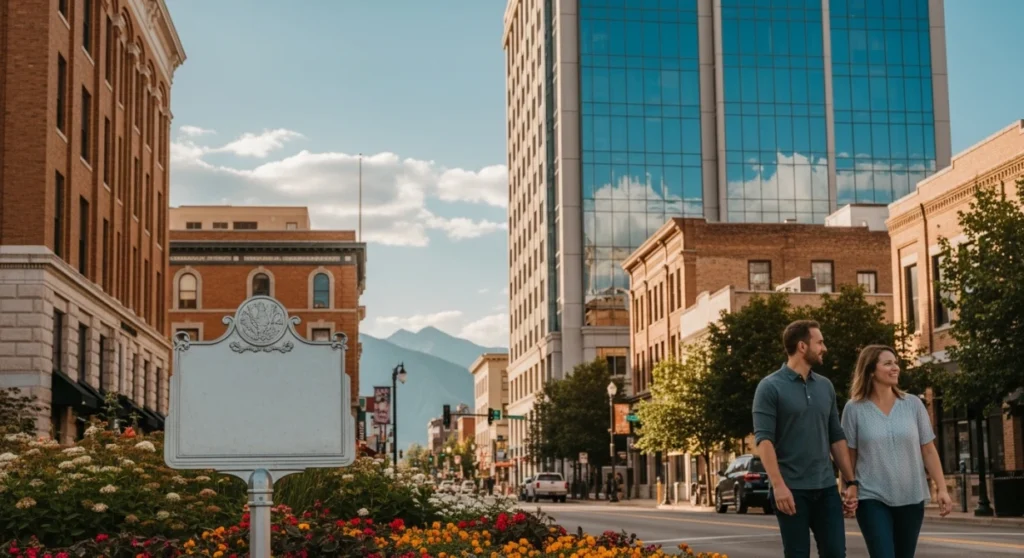
Downtown Salt Lake’s plaques give useful basics, but they often miss erased, uncomfortable, or easy-to-overlook history. A small-group local walk adds the context, connections, and questions that self-guided wandering usually cannot.
A traveler can read a few bronze plaques downtown and come away thinking Salt Lake City is tidy, straightforward, and fully explained. Standing in the same spot with a local guide, you start hearing a different city. One with vanished immigrant districts, respectable facades that covered rougher uses, and a tornado that many visitors would never guess hit the urban core.
This question sits inside a bigger travel decision: are plaques and a quick search enough, or is a guided downtown walk worth your limited time? For visitors comparing things to do near Salt Lake City, this matters because downtown can look visually legible while still hiding its most revealing stories in plain sight.
We build our downtown walks around that gap. The point is not to dismiss plaques. It is to show where they stop, what they flatten, and how much easier the city becomes to understand when someone connects one corner, alley, and building to the next.
Are plaque signs and short online blurbs enough to understand downtown Salt Lake?
No. Plaques are helpful for quick orientation, but they are too short to explain erased neighborhoods, uncomfortable history, or how one site relates to the next block.
That myth feels believable because downtown Salt Lake looks orderly. Streets are broad, many buildings appear well interpreted, and the city’s planned look encourages visitors to assume the official story on a sign is the whole story.
In practice, plaques usually do three things well and three things poorly. They identify a building, give a date, and summarize a sanctioned public narrative. They rarely linger on vice districts, displaced communities, vanished streetscapes, or events whose physical traces have been rebuilt away.
That is why self-guided plaque reading often leaves visitors with facts but not meaning. You may learn what a building was called or when it went up, yet miss why the site mattered, what stood nearby, and what tensions shaped the block around it.
- Why visitors assume plaques are enough: downtown looks compact, walkable, and documented.
- What plaques usually leave out: social conflict, marginalized communities, and the relationship between sites.
- What changes on a guided walk: you get the missing context while you are standing where the story happened.
If your goal is to truly read the city rather than just identify landmarks, do not treat the sign as the final answer. Treat it as the starting clue.
Myth: Regent Street is just a polished downtown lane with arts and redevelopment
Fact: Regent Street, formerly Commercial Street, was the center of Salt Lake City’s late-19th- and early-20th-century red-light district. Today’s clean streetscape gives little visual warning of how different the area once was.
This myth exists because the present-day setting is so composed. A visitor sees a redeveloped corridor, public-facing businesses, and a comfortable downtown lane that fits the city’s polished image.
The historical reality is more complicated. Commercial Street was long associated with brothels and illicit establishments, making it one of the clearest examples of how public memory can become selective when a district is remade. A brief sign, if present, cannot easily carry the full social history of vice, regulation, reputation, and redevelopment without becoming either oversimplified or sanitized.
That missing layer matters because it changes how you interpret the street. Instead of seeing only a pleasant passageway, you start noticing how downtown contained spaces that were economically active, morally contested, and later rebranded for a different civic identity.
What to do instead is ask a better on-the-ground question: what is this street hiding behind its current look? On our Salt Lake City Walking Tours, we design downtown routes to combine major landmarks with smaller corners and hidden places precisely because those are often where the city’s sharpest contrasts live.
A small group helps here. If you are curious how a red-light district could sit within an orderly downtown, or how redevelopment changes public memory, you can ask in the moment and keep following that thread instead of moving on after one plaque-sized summary.
What a self-guided visitor might miss on this block
- Scale: the story was not one isolated business but a district identity tied to the street.
- Contrast: the current built environment softens the street’s older reputation.
- Connection: the site makes more sense when linked to downtown growth, commerce, and image-making.
The practical takeaway is simple. If a street feels too neat to have had a messy past, that is often the first sign you should want more than the plaque gives you.
You found a hidden promo code!
Use code WOWBLOG at checkout and get 10% OFF any tour!
Limited time offer. Book now and save!
Browse ToursMyth: If there is little to see in Plum Alley today, there is not much history there
Fact: Plum Alley was Salt Lake City’s original Chinatown, established in the 1860s as a cultural and commercial hub for Chinese immigrants. Its importance is easy to miss precisely because so little of it announces itself in the current streetscape.
This is one of the most common plaque-era misunderstandings. Visitors trust what is visible, so when a place lacks a dramatic preserved facade or obvious district branding, they assume the history must have been minor.
Plum Alley shows the opposite. The area mattered as a center of community life and commerce for Chinese immigrants, yet that past is largely invisible now. This is the kind of urban history that gets thinned out twice: first by physical change, then by short-form interpretation that cannot fully address exclusion, erasure, and everyday life in one paragraph of public text.
Guided context changes what you notice. Once you know you are standing near the city’s original Chinatown, absence itself becomes evidence. You start asking why this story is harder to see, which communities leave more visible monuments, and how redevelopment can erase memory even when the location remains.
What to do instead is not chase a dramatic visual reveal that is no longer there. Look for interpretation that restores the human layer: who lived, worked, traded, and gathered here, and why that history became so easy to overlook.
This is also where small groups matter more than many travelers expect. People often have questions about how to talk about erased immigrant history respectfully, and a conversation on the street is more useful than a polished but brief sign that cannot handle nuance.
Practical clarification
You do not need to be a hardcore history buff to care about Plum Alley. You just need to want a truer downtown picture, one that includes communities that helped build the city even when the present-day block no longer advertises that fact.
Myth: The Eagle Emporium is just an old building with a standard pioneer-era plaque
Fact: The Eagle Emporium Building, built in 1864, is the oldest existing commercial building downtown and the first home of ZCMI. That makes it more than a surviving structure. It is a key clue to how early commerce took shape in Salt Lake City.
This myth appears because older commercial buildings often get reduced to age and architecture. A plaque may note construction date and name, but that can leave visitors with a shallow impression: old building, nice facade, move on.
The stronger reading is about continuity and role. When you know the building dates to 1864 and housed the first ZCMI location, it stops being a generic relic and becomes a marker of how organized urban commerce emerged in the city. That helps explain why downtown developed the way it did and why some seemingly ordinary storefront corridors carry deeper commercial ancestry than modern retail streets suggest.
This kind of site is where guides can connect planning, business history, and the built environment without turning the walk into a lecture. We focus on how the city was planned, built, and changed over time, so a building like Eagle Emporium becomes a pivot point rather than a disconnected factoid.
What to do instead of reading only the plaque is to ask two practical questions at buildings like this: what does its survival tell you about the age of the commercial core, and what institutions began here that shaped later downtown growth? Those questions open the story far beyond the metal sign.
Why this matters for non-specialists
You do not need prior knowledge of local retail history for this stop to be interesting. The appeal is seeing how a modern downtown can hide very old commercial layers behind streets that otherwise feel newer and more uniform than they really are.
Myth: If there is no obvious memorial downtown, the 1999 tornado was probably minor
Fact: The August 11, 1999 tornado was an F2 event with winds above 100 mph that struck downtown Salt Lake City, causing one death and many injuries. It is easy to miss today because cities repair storm damage, and because many visitors do not expect a tornado story in this setting at all.
The myth survives because Salt Lake sits in an arid, mountain-framed environment that most people do not associate with tornadoes. If they know the event happened at all, they often imagine it as an odd weather footnote rather than a disruptive downtown event.
But this is exactly the kind of history plaques underplay. A tornado does not fit the neat heritage script many visitors expect from the city center, and once physical damage is repaired, the streetscape stops signaling the scale of disruption. Without context, you can pass through downtown and never realize a rare and violent weather event reshaped the day-to-day life of the core.
What to do instead is treat recent history as part of the same interpretive puzzle as 19th-century history. Cities are not only founded and built. They are also interrupted, repaired, and reimagined after shocks. Knowing about the 1999 tornado makes downtown feel less static and more like a lived place that has absorbed surprises as well as long-term planning.
This example is also useful for skeptical visitors who think downtown Salt Lake does not have enough layers to justify a guided walk. A city does not need to look old in every direction to have stories that are surprising, specific, and place-bound.
How does a guided small-group walk change what you actually notice?
A guided small-group walk turns isolated facts into a coherent map of downtown. Instead of collecting plaques one by one, you start seeing how vice districts, immigrant enclaves, early commerce, planning decisions, and later disruptions all share the same few blocks.
The difference is not just more information. It is sequence, comparison, and the ability to ask questions in real time. A static sign cannot pause to explain why one vanished site matters more than its appearance suggests, or why a polished lane deserves a second look because of what it used to be.
Because our groups are small, guests can follow their curiosity without getting lost in a large-tour script. One person may want more on urban development. Another may ask about hidden places, building reuse, or how downtown orientation helps with the rest of the trip. That flexibility is exactly what self-guided plaque reading lacks.
| Approach | What you gain | What you are likely to miss | Best fit |
|---|---|---|---|
| Self-guided walk with plaques | Basic dates, names, and a flexible pace | Connections between sites, erased history, and answers to follow-up questions | Travelers who only want a quick look |
| Large general sightseeing format | Broad overview and efficient coverage | Detailed discussion of easy-to-miss corners and personalized questions | Visitors prioritizing breadth over depth |
| Small-group local downtown walk | Context, conversation, hidden places, and a stronger mental map of the city center | Less total area than a wide vehicle-based overview | Visitors who want to understand downtown, not just pass through it |
For many short-stay travelers, the biggest advantage is efficiency. A well-designed downtown walk works especially well on your first day because it gives you context, layout, and story all at once, which makes every later museum stop, restaurant choice, or neighborhood detour more intelligible.
When is booking a downtown walking tour worth it, and what should you expect?
Booking is worth it when you want more than labels on buildings, when your time is short, or when you suspect the city has hidden layers you will not spot alone. Expect a small-group walk led by a local guide, with routes that mix landmark buildings, planning and development stories, and easy-to-miss places.
If you are deciding between wandering and booking, use a practical threshold. Choose self-guided exploration if you are happy with surface-level context and do not mind leaving questions unanswered. Choose a guided walk if you want the city to make sense early in your trip and you value the ability to ask why one site matters to another.
- Book a guided walk first if downtown is your orientation point for the rest of your stay.
- Check route details before reserving so the duration, distance, and terrain match your pace and comfort level.
- Choose guided over DIY if the stories that interest you are invisible or underplayed in today’s streetscape.
- Lean toward small groups if you know you will ask questions or want a more conversational experience.
- Keep your expectations realistic by remembering that not every route guarantees every micro-site, but the approach is designed to go beyond the plaque version of downtown.
This is also the best answer to the objection, “I am not really a history person.” A good downtown walk is not a recital of dates. It is place-based storytelling that mixes architecture, city planning, everyday life, and the kinds of surprising examples that make a block memorable.
If you are choosing your next step, review the route descriptions on the Salt Lake City Walking Tours page. We list duration, distance, and terrain so you can pick a downtown walk that fits your time, pace, and interest level.
If your trip also includes time beyond the city core, our Utah day tours are the natural follow-up after you have your downtown bearings. But for understanding what Salt Lake is hiding in plain sight, a walk through the center is the smartest starting point.
What should you do instead of relying only on plaques?
Use plaques as prompts, not final verdicts. The best replacement is a guided downtown walk that helps you spot where the public story is thin, then gives you the missing context while you are standing in the right place.
If you still plan to explore on your own, at least judge each site by the right signals. Ask whether the place looks heavily redeveloped, whether the history involves a marginalized community, whether the event left little physical trace, and whether the sign explains the surrounding area or only the single building in front of you.
- Look for gaps: if a sign names a site but not the surrounding district, there is usually more to know.
- Be alert to absence: vanished neighborhoods and immigrant histories are often least visible where they mattered most.
- Question polished streetscapes: redevelopment often hides contentious uses from earlier eras.
- Treat recent events as history too: rebuilt downtown blocks may conceal major disruptions such as the 1999 tornado.
- Start early in your trip: context gained on day one improves the rest of your city time.
The practical boundary is important. No tour, plaque, or article can tell every story on every block. What a strong guided walk does better than solo wandering is help you notice where the city is speaking clearly, where it is speaking quietly, and where it has nearly gone silent.
Downtown Salt Lake is far more layered than its signs suggest. Commercial Street’s red-light past, Plum Alley’s erased Chinatown, the Eagle Emporium’s early commercial role, and the 1999 tornado all show how much disappears when you rely on brief official summaries alone.
If you want a quick stroll, plaques are fine. If you want to understand how the city was planned, built, and changed, a small-group local walk is the more useful choice, especially early in your visit.
Review the route details on the Salt Lake City Walking Tours page and book the downtown walk that fits your schedule.
Why do downtown plaques often feel incomplete?
They are built for short public reading, so they usually prioritize names, dates, and approved summaries over deeper social context or links to nearby sites.
What is the clearest example of a hidden downtown story?
Regent Street is a strong example because its current polished appearance hides the fact that it was once the center of the city’s red-light district.
Is Plum Alley still visually recognizable as Chinatown?
Not in an obvious way. That is exactly why guided context matters there, because the historical importance is much easier to miss than at a preserved landmark.
Why does the Eagle Emporium matter beyond being old?
Its 1864 construction date and role as the first home of ZCMI make it a key marker of early downtown commerce, not just a surviving historic facade.
Was the 1999 tornado really a major downtown event?
Yes. It was an F2 tornado with winds above 100 mph that caused one death and many injuries, even though little in the rebuilt streetscape now announces it.
Who gets the most value from a small-group downtown walk?
Visitors with limited time, first-time travelers, and anyone who wants to ask questions and connect sites into one clear story usually get the most from it.
How can I tell if a tour fits my pace?
Check the published route information for duration, distance, and terrain before booking so you know what kind of city walking experience to expect.
 How to Plan a Day Tour Around Your Salt Lake City Flight
 Antelope Island Sunset Tours: How Wildlife Viewing Really Works
 Antelope Island Day Tours: How to Plan a Low-Stress Visit
 Bonneville Salt Flats Sunset Tours: What the Experience Includes
 Bonneville Salt Flats Tours: Plan a Comfortable First Visit
 How to Plan a Utah Day Tour During a Short Salt Lake City Stay

Very happy with the whole experience, Dmitro was an excellent tour guide, very knowledgeable about area...
Read more →Matei Travel was the vendor for the trip. Don\'t use them. The tour was not as...
Read more →I would highly recommend touring with Dima! He was so knowledgeable and personable, and very open...
Read more →Experience was fabulous!!! We saw spectacular views of the flats, bison and prong horn. Mateo travel...
Read more → Antelope Island – Wild Heart of the Great Salt Lake Adventure
 Antelope Island Sunset Wildlife Expedition – Great Salt Lake Odyssey
 Bonneville Salt Flats – Sunset Adventure of the White Desert
 Bonneville Salt Flats – Journey to the Edge of the World