
Coach Bus Excursions Visiting Multiple Utah Parks With Wheelchair…
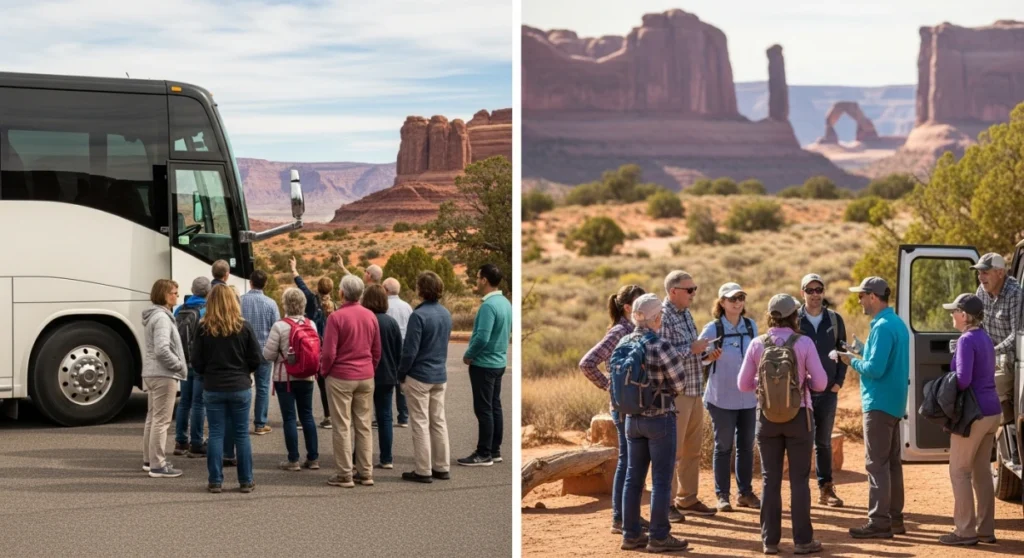
Choose a coach bus when long highway comfort matters most and your group is fine with rigid stops. Choose a small-group tour when in-park flexibility, shorter walks, and easier guide support matter more to the day.
Travelers often assume the biggest vehicle is the most accessible option. In Utah’s parks, that is only partly true, because the easy part is getting to the park and the harder part is what happens after arrival: where you can park, how far the overlook is from the vehicle, how long the group waits, and whether the day can adjust to one traveler’s pace.
This choice sits in the broader category of accessible guided touring, and it matters most for families, couples, and mixed-ability groups trying to visit several Utah parks without turning the trip into a sequence of stressful transfers. We organize tours and excursions in Utah, from city walking tours to day trips and national park experiences, so we look at accessibility as a full-day experience rather than just a vehicle feature.
What does “accessible” Utah park touring really mean in practice?
Accessible park touring means more than having a seat on a vehicle that can carry you long distances. It means the traveler can comfortably reach meaningful views, manage the day’s pace, find restrooms when needed, and avoid exhausting transfers or long waits.
For wheelchair users and travelers with limited stamina, the most important questions are practical. Is the stop on pavement or rough ground? Is the viewpoint right by the parking area or after a noticeable walk? How exposed is the stop to heat, wind, or cold? Is there a bathroom nearby, and is it realistic to get there without rushing?
Utah adds another layer because park infrastructure varies. Some parks use shuttles in certain areas, while others require visitors to rely entirely on their own transportation, which makes vehicle size and parking access more important than many travelers expect.
- Surface type: Pavement, packed path, uneven rock, and curb transitions can change whether a stop feels easy or tiring.
- Distance from parking: A famous overlook may still require more energy than expected if the parking lot is not close.
- Waiting time: Large groups often mean longer loading and unloading, which can drain energy even before the sightseeing starts.
- Weather exposure: Utah sun, wind, and elevation can make a short outing feel much harder.
- Bathroom timing: A good itinerary accounts for facility access, not just scenic highlights.
- Shuttle reality: In parks without internal shuttle systems, the tour vehicle itself determines how conveniently you can move between stops.
That is also why we put so much value on route clarity. On our Salt Lake City Walking Tours, we already publish route details such as duration, distance, and terrain so travelers can judge whether a day suits their energy level. That same planning mindset matters even more in the parks, where a “short stop” can feel very different depending on mobility needs.
Which option usually works better: coach bus or small-group tour?
A coach bus usually wins when the top priority is long-distance comfort over many highway miles and the traveler is satisfied with a more standardized day. A small-group van or minibus usually wins when the priority is what you can actually enjoy inside the parks once you arrive.
The core tradeoff is simple. Large vehicles can be comfortable for transport, but they are less nimble at scenic pullouts, regular parking areas, and stop-by-stop adjustments. Smaller groups can often create a smoother day on the ground, even if the vehicle itself is less “big trip” in feel.
| Decision factor | Large coach bus | Small-group van or minibus |
|---|---|---|
| Highway comfort | Often better for long stretches | Usually good, but less spacious |
| Boarding flow | Can take longer with a big group | Usually faster with fewer passengers |
| In-park parking flexibility | More constrained by oversize parking | Usually easier to fit near key stops |
| Pace adjustments | Limited by group schedule | Easier to adapt to one traveler’s needs |
| Guide interaction | Harder in a large group | Easier to ask questions and get help |
| Mixed-ability travel | Can work, but less flexible on timing | Often easier to balance different abilities |
| Noise and crowding | More people, more waiting | Quieter, more personal experience |
| Stop selection | More standardized | Better for choosing realistic, high-value stops |
If your definition of success is “cover the distance,” the coach format can make sense. If your definition is “comfortably experience the best overlooks and not spend the day managing obstacles,” the smaller format is often the stronger choice.
How do coach bus tours compare with small groups for wheelchair and limited-mobility travelers?
Coach tours offer scale and transport comfort, while small groups offer agility and human attention. For limited-mobility travel in Utah’s parks, that second advantage often matters more once the day becomes stop-based rather than highway-based.
Many travelers feel safer starting with a large bus because it looks more formal and substantial. That instinct is understandable, but a park day is shaped by details that the vehicle alone does not solve: how close you can park, whether the guide can slow down explanations, and how much extra time is lost every time the full group gets on and off.
- Vehicle access: A coach may have features that support boarding, but you must confirm exact equipment and securement details with any operator. A small-group operator may have fewer onboard assumptions, so technical compatibility must also be checked directly.
- Help from the guide: In a small group, it is usually easier to ask for a slower pace, a nearby viewpoint, or a clearer description of terrain before you commit to getting out.
- Stress level: Big groups can create pressure to move quickly. Smaller groups usually make it easier not to feel like you are holding everyone up.
- Stop quality: A smaller vehicle can often focus on fewer, stronger stops instead of a long list of marginal ones.
- Group dynamics: Families and mixed-ability parties often appreciate being able to split a stop naturally, with some taking a short walk and others enjoying the view near the vehicle.
We prefer small groups because they make it easier for guests to ask questions and for guides to adjust pacing and explanations. That is already visible in how we run intimate city tours with local guides, and the same logic carries into national park planning where flexibility has a direct impact on comfort.
How do coach bus excursions through multiple Utah parks typically work, and where do they fall short?
Coach-based multi-park trips usually work best as long-distance sightseeing transportation with scheduled scenic stops. They fall short when accessibility depends on quick parking, individualized pacing, or getting close to the most convenient viewpoint entrances.
On paper, the format can look ideal. A large bus can handle the road miles and keep travelers together, which is appealing on a multi-day or multi-park route. The problem is that park access is not just about whether the road is open to big vehicles. It is also about what happens at crowded viewpoints and trailhead parking areas once everyone wants to get off at the same time.
In parks such as Arches, large vehicles can drive the scenic road, but parking for oversize vehicles is limited, especially in busy periods. That can reduce spontaneity and force the trip toward the stops that best fit the bus rather than the stops that best fit the traveler.
There is also a guiding limitation that many people do not think about. Commercial group activity rules in some national parks can restrict where guided interpretation happens, which means the off-bus experience may stay concentrated in paved or designated areas instead of becoming a flexible, stop-by-stop adaptive outing.
- Hidden cost in time: Longer loading and unloading can eat into the moments that matter most.
- Hidden cost in energy: Waiting seated on the bus is still tiring when the day is long and the group is large.
- Hidden cost in choice: The stops may be technically accessible to the bus, but not especially convenient for the traveler.
- Best fit: Travelers who prioritize transportation simplicity, broad sightseeing, and a set schedule over customization.
That is why we treat coach travel as a valid option, not an automatic answer. It can be the right tool for the highway portion, but not always the best tool for the actual park experience.
You found a hidden promo code!
Use code WOWBLOG at checkout and get 10% OFF any tour!
Limited time offer. Book now and save!
Browse ToursWhy are small-group van and minibus tours often more usable inside Utah’s parks?
Small-group tours are often more usable because the vehicle is easier to place near realistic stops and the guide can adapt the day around how one guest is doing. For many travelers with mobility needs, that makes the experience feel calmer, fuller, and less rushed.
Smaller vehicles interact better with regular parking and pullout patterns inside many parks. That does not guarantee every stop will work for every wheelchair or mobility device, but it often improves the odds that the group can reach the stops that offer the best ratio of scenery to effort.
Guide attention also changes the day in a meaningful way. In a small group, it is easier to describe the next stop before arrival, estimate how far the overlook is from the vehicle, and shift emphasis from a marginal walk to a more rewarding near-road viewpoint if energy is dropping.
This format also serves mixed-ability groups well. One person may prefer to stay close to the vehicle while another takes a brief walk, and the guide can keep both experiences connected through timing and interpretation rather than forcing everyone into the same exertion level.
That is the thinking behind our Utah National Parks Tours. We design these tours around realistic sightseeing, with clear descriptions of duration, daily rhythm, walking level, and major stops, so travelers can compare the route to their own stamina and mobility needs before choosing.
What park-specific realities in Utah most affect this decision?
The biggest realities are parking size, whether the park has an internal shuttle system, and how much of the signature scenery is close to the road. Those factors often make a smaller vehicle more practical, even when a coach bus is comfortable between parks.
Arches National Park
Arches is a good example of why “the bus can drive there” does not settle the question. Large vehicles can use the scenic road, but parking for oversize vehicles is limited, which can make access to popular viewpoints less convenient than many travelers expect.
For a wheelchair user or a traveler with reduced stamina, that can mean a day defined by parking constraints rather than by the best easy-access views. A smaller vehicle often has an easier time turning a scenic drive into a series of workable stops.
Canyonlands National Park
Canyonlands has no internal shuttle to solve transportation gaps for visitors. That means the tour vehicle itself has to do the practical work of getting you close to overlooks, and oversize parking limitations matter more.
This is one of the clearest cases where accessibility is about arrival convenience, not only road legality. If the aim is to enjoy key rim views with minimal extra strain, parking flexibility becomes a major advantage.
Zion and Bryce Canyon
Zion and Bryce bring a different mix of issues, including shuttle patterns in some areas, weather exposure, and the difference between a quick viewpoint stop and a more involved walk. In these parks, the best format depends on whether your day is built around iconic overlooks near access points or around a rigid sweep of many stops.
For limited-mobility travelers, the best experience often comes from choosing a few high-impact locations and allowing enough time at each one. That is easier to execute in a smaller group than in a full coach itinerary that has to keep many passengers on the same timetable.
If you are still deciding where to start, one related planning question is picking the closest national parks to Salt Lake City for a weekend road trip. Starting from realistic drive times and a manageable stop count usually leads to a better accessibility outcome than trying to pack too many parks into one ambitious run.
When does the verdict flip in favor of a coach bus?
The verdict flips toward a coach when the traveler values long-distance seated comfort more than flexible in-park access, or when the trip is primarily about broad sightseeing from the road. It can also be a practical choice if the party is comfortable accepting standardized stops and a fixed pace.
This matters for travelers coming from farther away or covering several regions in one trip. If the park visits are short, mostly scenic, and not centered on close-access overlooks, a coach can still be a reasonable option.
That said, many people discover too late that comfort on the highway does not guarantee comfort at the destination. If your traveler’s energy is limited, or if a wheelchair user needs the day shaped around realistic stop logistics, the smaller format often returns more value where it counts.
What are the most common mistakes people make when choosing?
The biggest mistake is choosing based on vehicle size instead of choosing based on the actual day on the ground. The second mistake is failing to confirm technical mobility details and route specifics before booking.
- Assuming bus size equals accessibility: A large vehicle may help with transport, yet still lead to inconvenient stops or more waiting.
- Ignoring parking realities: Oversize parking limits can change what feels easy once you are inside the park.
- Underestimating transfer fatigue: Repeated loading, unloading, and waiting can be harder than one modest walk.
- Not asking about terrain: “Short walk” is too vague. Ask whether the route is paved, sloped, exposed, or uneven.
- Trying to do too much: A smaller number of excellent, accessible viewpoints usually beats an exhausting checklist.
- Staying quiet about mobility needs: Tour planning only works when the operator knows what equipment, stamina, and assistance level to plan around.
What should you ask a tour operator before booking?
You should ask about the exact vehicle setup, boarding process, stop surfaces, distance from parking to viewpoints, bathroom timing, and how much the guide can adjust the day. Those answers matter more than a generic statement that the trip is “accessible-friendly.”
- What vehicle is used on my date? Confirm whether it is a coach, van, or minibus and ask what mobility equipment it can realistically accommodate.
- How does boarding work? Ask about steps, timing, storage, and whether a wheelchair or mobility device can be carried safely on that trip.
- Which stops are near the vehicle? Ask for examples of viewpoints that usually require minimal walking.
- What are the surfaces like? Find out whether the main stops are paved, packed, uneven, or exposed.
- How flexible is the pace? Ask whether the guide can shift time between stops if one traveler needs more time.
- How are bathroom breaks handled? This is essential for comfort on longer park days.
- What happens in a mixed-ability group? Ask how the guide balances brief walks for some travelers with scenic access for others.
When travelers contact us about mobility needs, we help interpret route descriptions and match them with the kind of tour format that is likely to feel comfortable and worthwhile. For some visitors, that means a park itinerary. For others, it means beginning with a lighter day first.
Which type of Matei Travel tour should you consider next?
If you want the best chance of a flexible, lower-stress park day, start by reviewing small-group national park and day tour options. If you are unsure how your energy or mobility will feel in Utah, a gentler first-day city experience can be the smartest starting point.
Our Utah Day Tours are useful for travelers who want scenic Utah experiences without committing immediately to a longer multi-park run. They can also work as a lower-exertion test day to see how transportation, pacing, and short walking segments feel in practice.
For travelers just arriving in the state, our small-group Salt Lake City Walking Tours can be a gentle way to ease into the trip. Because these tours are led by local guides and include clear route descriptions, they help set expectations around distance, terrain, and pacing before you move on to more demanding park days.
The practical next step is to compare the route descriptions on the park and day tour pages against your own mobility needs, then reach out directly with the details of your wheelchair or mobility device, transfer ability, stamina, and must-see priorities. That makes it much easier to recommend whether a small-group national park itinerary, a day tour, or a simpler city outing is the best fit.
How can you make the final decision with confidence?
You can make the decision by focusing on the part of the day that matters most to your traveler: the ride between parks or the experience at each stop. Once that priority is clear, the right format usually becomes obvious.
- Pick a coach bus if: long seated travel comfort is your top priority, you are comfortable with a fixed plan, and you do not need much stop-by-stop adjustment.
- Pick a small group if: you want better in-park usability, easier communication with the guide, and a calmer pace for a wheelchair user or limited-mobility traveler.
- Pick a gentler option first if: you are unsure about stamina, altitude, or how a full park day will feel.
- Always confirm: vehicle compatibility, boarding details, terrain, and bathroom rhythm before booking.
For most wheelchair and limited-mobility travelers touring Utah’s parks, the best choice is the format that reduces friction after arrival, not just during the drive. Coach buses can be strong for transport, but small groups usually create a better park day when pacing, parking, and guide attention matter. The clearest path is to compare route details honestly against your own needs, then choose the trip built around realistic stops rather than maximum miles. Review the Utah National Parks or day tour options and contact Matei Travel for help matching your mobility needs to the right itinerary.
Is a large coach bus always the most accessible option for Utah parks?
No. It may be comfortable for long road segments, but inside the parks a smaller vehicle often makes stops easier and reduces waiting.
If I use a wheelchair, should I avoid small-group tours?
Not automatically. The key step is confirming exact vehicle and equipment compatibility before booking, then matching the route to your comfort level.
Are Utah’s best park views only for people who can hike?
No. Many memorable views come from overlooks and roadside stops, so a well-planned day can still feel rewarding without long walks.
What matters more than the vehicle itself?
Parking access, distance from the vehicle to the viewpoint, bathroom timing, and whether the guide can adapt the pace usually matter more to comfort.
Why can a small group work better for a mixed-ability party?
It is easier to let one traveler stay near the vehicle while others take a short walk, without turning the stop into a complicated production.
Should I start with a big national park tour on my first day in Utah?
Not always. Some travelers do better by starting with a lighter city or day tour so they can judge energy, pacing, and terrain before a longer park outing.
What is the most important question to ask before booking?
Ask for specifics, not labels: how boarding works, what terrain to expect, how far viewpoints are from parking, and how flexible the day can be.
 Should You Cancel a Utah Outdoor Day Because of Wildfire Smoke?
 When Should a Utah Park Day Trip From Salt Lake City Become an Overnight?
 Your First Evening in Salt Lake City: A Low-Pressure Orientation Plan
 Bonneville Salt Flats Photography Etiquette: How to Protect the Surface and Share the View
 How to Plan an Antelope Island Birdwatching Visit
 Why Are There So Many Brine Flies on Antelope Island?

Guide was Great! The salt flats had alot of water due to recent rain which limited...
Read more →I booked the Bonneville Salt Flats tour w Matei bc the owners are Ukrainian. I’m so...
Read more →This experience is a must-do! Dima explains the history of the area as well as the...
Read more →I had never been on a guided tour before, but Dima made it the best experience...
Read more → Antelope Island – Wild Heart of the Great Salt Lake Adventure
 Antelope Island Sunset Wildlife Expedition – Great Salt Lake Odyssey
 Bonneville Salt Flats – Journey to the Edge of the World
 Bonneville Salt Flats – Sunset Adventure of the White Desert