
Canyonlands Sunrise Jeep Photo Runs: What to Expect Before You Book
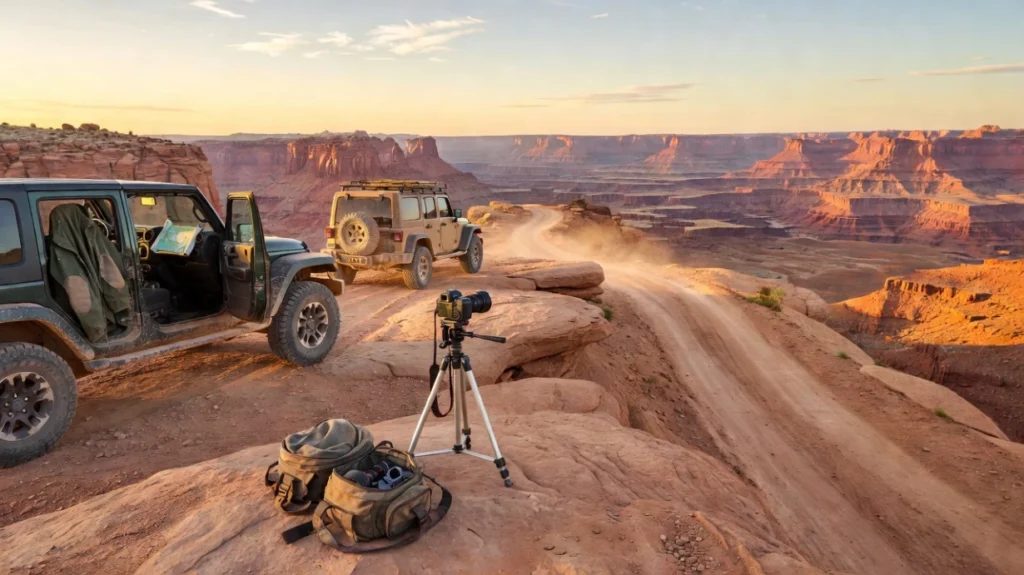
A sunrise Jeep photo run in Canyonlands is a legal, pre-planned way to reach a small number of good sunrise shooting spots on designated roads. Expect an early start, careful timing, limited route flexibility, and more time composing than thrill-riding.
Many travelers picture a dawn Jeep outing in Canyonlands as free-roaming desert access with endless location choices. The reality is more disciplined than that, and that is exactly why a well-planned morning can be worth booking if your real goal is better light, calmer shooting time, and fewer preventable mistakes in the dark.
This is a photography-focused park outing, not a generic scenic ride. It matters most for visitors who want to understand what the morning actually feels like on the ground, what National Park Service rules change for photographers, and how to fit that sunrise window into a broader Utah trip without wasting it on guesswork.
When is a sunrise Jeep photo run in Canyonlands the right fit?
A private sunrise Jeep photography run in Canyonlands focused on light and composition is the right fit if you care more about being in the correct legal spot at the correct minute than about covering lots of attractions. It works best for travelers who want a small-party, photo-first morning with realistic pacing and help handling pre-dawn logistics.
In practice, this kind of outing suits visitors who enjoy deliberate shooting, whether they use a phone, a compact camera, or a more advanced setup. You do not need to be a professional photographer. You do need to enjoy waiting for light, working one scene for a while, and accepting that park rules shape what is possible.
- Good fit: You want sunrise to be a priority, you prefer a slower pace at a few stops, and you would rather not navigate unfamiliar roads in the dark.
- Good fit: You are building a Moab or wider Utah parks trip and want this morning to connect cleanly with the rest of your itinerary.
- Less ideal: You mainly want an adrenaline-heavy off-road ride or a fast checklist of viewpoints.
- Less ideal: You expect unrestricted route choice, off-route wandering, or light-painting after dark.
We treat this as a planning problem first. Our role is to shape the morning around your photo goals, your comfort with short walks, and the legal access available that day, then fit it into a larger Utah schedule instead of leaving you to improvise.
What does “private sunrise Jeep photography run” actually mean here?
Here, it means a privately arranged, small-party morning built around shooting conditions, not around a standard sightseeing script. The vehicle is a tool for reaching legal access points efficiently before dawn, while the pace on site is set by light and composition rather than by a crowded stop list.
The “private” part matters because sunrise is sensitive to timing, setup speed, and how much tripod space people need. A photo-oriented outing usually works better when there is room for questions, room to pause, and less pressure to rush every stop. That approach matches how we structure guide-led experiences in Utah more broadly, with realistic pacing and space for conversation rather than a constant push from one checkpoint to another.
It also differs from a basic Jeep sightseeing tour in one important way. On a sightseeing run, the drive itself may be the main event. On a photo run, the drive is supporting infrastructure. The useful question is not “how rough is the route?” but “does this route get us somewhere legal, safe, and visually worthwhile before the color changes?”
What you are actually booking
- Pacing: Time is concentrated around a small number of sunrise-worthy stops instead of many quick pullouts.
- Logistics: Pickup timing, dark-morning navigation, and route selection are handled for you.
- Access realism: The morning is designed around designated roads, permit constraints, and what can be reached without fantasy-level flexibility.
- Trip fit: The outing can be built into a broader Canyon Country plan instead of standing awkwardly on its own.
You found a hidden promo code!
Use code WOWBLOG at checkout and get 10% OFF any tour!
Limited time offer. Book now and save!
Browse ToursWhat does a typical morning look like from pickup to return?
A typical sunrise run starts very early, reaches the shooting area before usable dawn light, and spends the best part of the morning at one or a few carefully chosen locations. After sunrise and early golden light, the outing either returns to your base or folds into the rest of your day’s park itinerary.
The key point is that the schedule is driven backward from sunrise, not forward from breakfast. If arrival is even a little late, the best color and the calmest setup window are already gone.
- Pre-dawn pickup or meeting: You meet very early, usually while it is still fully dark. This is when having the logistics handled matters most, because missed turns, slow loading, or uncertain departure timing directly cost shooting time.
- Drive in darkness: The route in is quiet and practical. This is not the glamorous part, but it is where experience and realistic planning save the morning.
- Arrival before civil twilight: The aim is to be out and getting oriented before the light gets interesting. You may set up, check foregrounds, and decide on one or two compositions before the fast color changes begin.
- Main sunrise shooting window: This is usually the most concentrated part of the outing. Contrast changes quickly in Canyonlands, and many scenes reward staying put long enough to watch the canyon walls and rim edges shift rather than jumping back into the vehicle.
- Golden-hour follow-up: After the sun clears the horizon, some scenes improve while others become too harsh. A good plan leaves room either to refine the first location or make one additional move that still makes visual sense.
- Return or continue the day: Some mornings end with a direct return for breakfast and recovery. Others feed into a full park day, depending on where you are staying and how the wider itinerary is built.
This is why we do not treat sunrise as a casual add-on. If you are coming on one of our Utah National Parks Tours, the smarter approach is usually to arrange the previous night so you sleep near the Moab area rather than trying to force a same-day dawn arrival from Salt Lake City.
Where can you realistically go by vehicle at sunrise in Canyonlands?
You can only go where street-legal vehicles are allowed on designated park roads, and that sharply shapes the morning. Some sunrise plans rely on paved access and established viewpoints, while others may use legal dirt roads, but route choice is never unlimited and permits can narrow it further.
This matters because many travelers assume a Jeep means broad freedom of movement. In Canyonlands, it does not. Vehicles must stay on designated roads, and off-highway vehicles such as ATVs and UTVs are not allowed in the park. So the question is not whether a spot looks drivable on a map, but whether it is legally open to the right vehicle and practical for a sunrise timeline.
| Access type | What it usually means for photographers | Main planning constraint |
|---|---|---|
| Main paved viewpoints | Predictable access, easier timing, simpler footing, and less uncertainty in the dark | Less route novelty and possible competition for obvious shooting positions |
| Designated dirt roads open to street-legal vehicles | Potentially more separation and a different angle on the landscape | Longer approach times, rougher travel, and stricter need for route realism |
| Permit-shaped routes such as White Rim Road day use | Ambitious access can be possible on paper | Permit availability and timing may rule out a plan or require a totally different morning |
Permits are another practical boundary. Overnight backcountry travel requires permits, and some roads, including White Rim Road, require day-use permits. That means a visually exciting idea may still be the wrong choice for your date, your comfort level, or the time budget available before and after sunrise.
What photographic opportunities does sunrise in Canyonlands actually create?
Sunrise in Canyonlands is strongest when you work with a few compositions and let the light come to them. The visual payoff usually comes from changing contrast, layered canyon depth, rim light, and the shift from blue pre-dawn tones to warm early sun, not from racing through many stops.
Canyonlands can look deceptively static in photos online, but in person the scene changes quickly. Deep canyons hold shadow while upper rims brighten first. Mesa and rim viewpoints behave differently from lower or more enclosed perspectives. That is why composition planning matters as much as transportation.
On a good morning, the useful creative choices are often simple. Decide whether you want big layered distance, a foreground edge that anchors the frame, or a cleaner graphic shape as the first sun hits selected formations. Then stay patient long enough to watch the scene settle into the version you want.
Why fewer stops often produce better results
- Settle your framing: You lose less time unloading, relocating, and claiming tripod space.
- Read the light: Early color often peaks and fades quickly, and a rushed move can cost the best minute.
- Handle contrast: Canyon scenes can swing from subtle dawn gradients to hard brightness fast, so staying in one place helps you respond.
- Keep the morning calm: A photo run should feel intentional, not like a scavenger hunt with camera gear.
This is also where expectations need to stay honest. No planner can guarantee perfect cloud cover, empty overlooks, or a specific “iconic shot.” What good planning can do is improve your odds of being in a legal, sensible position when the light is best.
What rules matter most to photographers on a guided sunrise outing?
The rules that matter most are simple but decisive: commercial operators need a valid National Park Service Commercial Use Authorization, vehicles must remain on designated roads, OHVs are banned, and artificial light cannot be used to illuminate landscapes or rock formations. These are not minor details. They determine the route, the shooting techniques allowed, and the kind of morning you should expect.
For photographers, the artificial light rule is often the biggest surprise. If you imagined lighting up foreground rocks or canyon walls during the twilight edge of the morning, that is not allowed in the park. The creative answer is to work with natural dawn progression instead of trying to overpower it.
The CUA requirement matters in a different way. A legal commercial sunrise outing is not just someone with a vehicle showing up before dawn. It must operate under the park’s commercial authorization rules and conditions. That is one reason serious planning tends to look less spontaneous from the outside than people expect.
- Stay on designated routes: You cannot drive off-route to improve an angle.
- No OHVs: ATVs and UTVs are not permitted inside Canyonlands National Park.
- No artificial lighting of park features: Light-painting landscapes and formations is off the table.
- Permits shape ambition: Some roads and all overnight backcountry use come with permit requirements.
Those limits do not ruin the outing. They simply shift the craft toward timing, legal access, and selecting locations that work with natural light rather than against the rules.
Who is responsible for what during the planning process?
The clearest division is this: we handle route logic, timing, park-rule-aware planning, and how the sunrise segment fits your wider trip, while you tell us what you want to photograph, where you are staying, and how much walking or rough-road travel you are comfortable with. When both sides are specific early, the morning becomes much more realistic.
Because this is best treated as part of a broader Utah itinerary, not an isolated fantasy concept, the planning conversation needs a few concrete inputs. If you are staying in Moab, the morning can usually be structured more efficiently. If you are starting in Salt Lake City, the smarter move is often to place Canyonlands after a travel day and sleep closer to the park.
| Stage | Our responsibility | Your responsibility | Acceptance check |
|---|---|---|---|
| Trip fit | Advise whether sunrise makes sense within your schedule | Share dates, lodging base, and nearby park plans | The morning fits without a punishing transfer before dawn |
| Photo goals | Translate your general ideas into a feasible approach | Describe what you like to shoot and your experience level | The plan matches your pace and expectations |
| Access planning | Build around legal roads and permit realities | Accept that some routes may not be available or suitable | The route is compliant and realistic for the time window |
| Morning execution | Handle timing, coordination, and navigation logic | Be ready on time with gear organized | You arrive early enough to set up before the key light |
If you are still deciding how this fits into the rest of your trip, our broader Utah National Parks Tours page is the practical place to start, because those itineraries already connect Canyonlands with other major Utah parks from Salt Lake City.
Will a guided run spend too much time driving, and is self-driving good enough?
A good photo-focused morning should spend its best light on location, not endlessly in the vehicle, but some driving is unavoidable because dawn access is the whole point. Self-driving can be cheaper and more flexible on paper, yet it puts navigation, timing, parking, road legality, and permit research entirely on you.
There is no need to pretend self-driving never works. If your target is an easy-access viewpoint, you already know the route, and you are comfortable being fully responsible for the timing, it can be a sensible choice. The tradeoff is that any mistake belongs to you as well, and sunrise does not wait for course correction.
Honest pros and cons
- Self-driving advantages: Lower cost, complete control over departure time, and the freedom to leave when you want.
- Self-driving drawbacks: Dark-morning stress, no help with route or permit logic, and a higher chance of wasting the narrow best-light window.
- Guided advantages: Clearer timing, better legal access planning, and less mental load when you should be thinking about framing.
- Guided drawbacks: Less spontaneous wandering and a stronger need to commit to a plan ahead of time.
For many visitors, the real value is not the vehicle itself. It is avoiding a chain of small errors that leave you stepping out of the car just as the best color disappears.
How physically demanding and rough is a sunrise Jeep outing?
Most legal sunrise outings in Canyonlands can be planned to focus on efficient access rather than extreme off-roading, so they are not automatically intense or highly technical. The comfort level depends on the chosen road, how much walking you want to do once on site, and how much uneven footing you can handle in low light.
This is a useful place to be specific before booking. Some travelers want minimal walking and straightforward pullout-style access. Others are happy with short walks to improve composition. Neither approach is wrong, but they lead to different morning designs.
We prefer to set this expectation early instead of forcing everyone into the same template. That mirrors how our guide-led outings generally work across Utah: realistic route descriptions, clear terrain expectations, and time for questions before the day starts.
How should you prepare, and what makes the morning go smoothly?
The best preparation is simple: organize your gear the night before, dress for a cold pre-dawn start, and know what kind of shooting pace you enjoy. A smooth morning depends less on exotic equipment than on being ready to step out and work quickly when the vehicle stops.
Because sunrise timing is unforgiving, small delays matter more than people expect. Searching for batteries, repacking lenses in the dark, or deciding on footwear at the last minute can waste the calmest setup period of the whole outing.
- Night-before setup: Charge batteries, clear memory cards, and pack so that your first camera or phone is immediately accessible.
- Clothing: Expect the pre-sunrise period to feel colder than the later morning, even if the day warms quickly.
- Footwear: Wear something stable enough for uneven ground around viewpoints and short walks.
- Tripod mindset: If you use a tripod, be ready to claim your space politely and stay put long enough to justify setting it up.
- Expectation setting: Decide in advance whether you prefer one carefully worked scene or several faster variations.
- Communication: Tell us ahead of time if you are brand-new to photography, traveling with non-photographers, or need a lower-intensity plan.
If you only have limited time in Utah and are trying to judge whether this belongs in a shorter trip, our Utah day tours can also help you think through how much pre-dawn structure you actually want versus a simpler scenic day.
How does this fit into a larger Utah itinerary, especially from Salt Lake City?
A Canyonlands sunrise is realistic within a Utah trip if you position the night before correctly, usually by sleeping near the Moab area rather than attempting a same-day dawn push from Salt Lake City. It works best as one planned segment inside a broader parks itinerary, not as an isolated long-distance dash.
This is where travelers often lose the plot. They spend hours trying to design a perfect dawn shoot, then place it after an unrealistic transfer day that ruins the only useful light window. The better approach is to treat sunrise as one fixed anchor and build the previous evening and next day around it.
That makes this a natural fit for multi-park Utah vacation packages focused on photography and small groups, especially when Canyonlands is paired with Arches and other southern Utah parks. The main planning decision is not just “Do I want sunrise?” but “Where should I sleep, and what should the following day look like so the sunrise effort actually pays off?”
How should you ask for this when planning with us?
The easiest way to request this is to describe the morning you want in concrete terms, not just say “sunrise in Canyonlands.” Give your date, where you will be staying, your photography experience, and whether you want a low-walking or more active plan.
That level of detail lets us tell you quickly whether the idea is feasible, what the morning should realistically prioritize, and how it can connect to your wider Utah route. It also helps us avoid a common planning mistake, which is overloading one day with too much driving before or after the dawn window.
- Date: Your preferred morning and any backup date flexibility.
- Lodging base: Whether you will be in Moab or elsewhere the night before.
- Experience level: Phone shooter, casual camera user, or more advanced photographer.
- Mobility and comfort: Interest in short walks, tolerance for rougher roads, and any limits that affect pace.
- Photo priorities: Big canyon layers, rim views, patient tripod shooting, or a simpler first-light experience.
- Trip context: Whether you want this folded into a larger parks itinerary from Salt Lake City.
Start with our Utah National Parks Tours and send a booking inquiry that specifies you want a private sunrise photography segment in Canyonlands, along with your date, lodging plan, and experience level.
A Canyonlands sunrise run is worth booking when you want legal access, sharp timing, and enough quiet on site to actually work a scene instead of chasing one. The tradeoff is reduced spontaneity, because the park’s rules, designated roads, and permit realities matter as much as the view. If you treat the outing as a photo-first morning inside a well-planned Utah itinerary, it can fit very well for both casual and experienced shooters. Explore the Utah National Parks Tours page and send Matei Travel your preferred date, overnight base, and photo goals to start shaping the morning around what you actually want to shoot.
Do I need to be an advanced photographer for this kind of sunrise outing?
No. It is more about having time in good light than about advanced technique, so it works well for travelers who enjoy patient shooting and basic camera control.
Can a sunrise run in Canyonlands include off-road vehicles like ATVs or UTVs?
No. OHVs are not permitted in Canyonlands National Park, so access must use street-legal vehicles on designated roads.
Can we use lights to illuminate rocks or canyon walls before sunrise?
No. Artificial light cannot be used to illuminate landscapes or formations in the park, so the morning has to rely on natural dawn light.
Is White Rim Road always an option for sunrise access?
No. Roads such as White Rim Road have permit requirements, and permit availability can change what is realistic for a specific date.
Would this normally work as a same-day trip from Salt Lake City?
Usually not as a smart sunrise plan. Most travelers should sleep closer to the Moab area the night before so the morning is not wasted on a long transfer.
Will we stop at many locations during the best light?
Usually no. A photo-first morning is typically stronger when it focuses on a few carefully chosen spots with enough time to set up and stay patient.
Is the Jeep part meant to be an extreme adventure ride?
No. On a legal photography outing, the vehicle’s main job is efficient access to allowed viewpoints, not thrill-focused off-roading.

Had a great tour with Dima. Very knowledgeable, fun and courteous. Highly recommend this tour guide....
Read more →Dima, owner and guide, is passionate in his advocacy for the health of Utah\'s parks and...
Read more →Such an amazing trip and experience. Dima is a cool tour guide, very humorous and willing...
Read more →Your was super thorough and guide was very helpful and informative throughout the tour
Read more → Antelope Island – Wild Heart of the Great Salt Lake Adventure
 Antelope Island Sunset Wildlife Expedition – Great Salt Lake Odyssey
 Bonneville Salt Flats – Sunset Adventure of the White Desert
 Bonneville Salt Flats – Journey to the Edge of the World