
Bryce Canyon Accessible Sunset Viewpoints and Shuttles for Wheelchair Users
Jun 21, 2026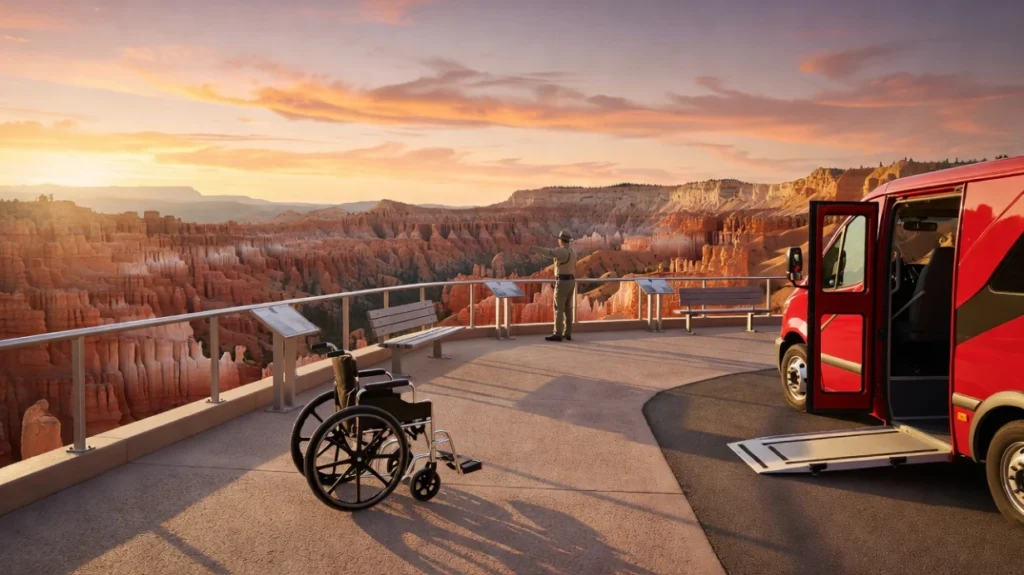
For most wheelchair users, Sunset Point is the most practical Bryce Canyon sunset target. During shuttle season, the free shuttle with wheelchair lifts is often the simplest way to reach it, especially if your vehicle is longer than 23 feet.
The mistake we see most often is treating a Bryce Canyon sunset like a casual last stop, then discovering too late that shuttle season, parking limits, and a long approach from Salt Lake City change the whole plan. For wheelchair users, this is not mainly about finding every overlook. It is about choosing the right one, arriving with enough margin, and knowing whether the evening fits the rest of the trip without turning the day into a grind.
This is a practical accessibility planning guide for wheelchair users, companions, and trip planners who want a realistic sunset stop at Bryce Canyon. We organize Utah park itineraries from Salt Lake City, so our focus is the part that actually decides success: viewpoint choice, shuttle use, parking rules, timing, and whether sunset belongs in a single long day or a broader park route.
Who is this guide for?
This guide is for wheelchair users, their travel companions, and anyone building a Utah parks trip that starts in Salt Lake City or includes Bryce Canyon in a multi-park loop. It is most useful if your main question is not “What is there to see?” but “Can we reach a good sunset view comfortably and on time?”
That includes mixed-ability groups too. When one person uses a wheelchair and others want a bit of walking, the best plan is usually to keep the sunset focus in the main amphitheater area instead of trying to string together too many overlooks late in the day.
Which Bryce Canyon sunset viewpoint should wheelchair users prioritize?
Sunset Point is the clearest first choice for most wheelchair users. It gives you one of the park’s signature amphitheater views without making the evening depend on multiple stops or long route changes.
According to Bryce Canyon National Park’s Sunset Point page, Sunset Point is one of the four major viewpoints of the Bryce Amphitheater, offers views of some of the park’s most famous hoodoos, and is wheelchair accessible. That combination matters more than variety at sunset, because it lets you focus your time and energy on one high-value stop.
For most travelers in a wheelchair, the practical ranking is simple:
- Must-do: Sunset Point. This is the most logical sunset target because it combines classic scenery with accessible access.
- Should-do if time and energy allow: Another major amphitheater viewpoint near your route, but only if it does not create a rushed transfer close to sunset.
- Nice-to-do: Extra overlooks outside your core sunset plan. These are bonus stops, not the evening’s main goal.
If your group wants both accessibility and flexibility, build the evening around Sunset Point and treat everything else as optional. That keeps the wheelchair user included in the main scenic moment instead of making sunset depend on a last-minute scramble.
You found a hidden promo code!
Use code WOWBLOG at checkout and get 10% OFF any tour!
Limited time offer. Book now and save!
Browse ToursHow accessible is Sunset Point in practical terms?
Sunset Point is accessible enough to be the most sensible wheelchair-focused sunset plan, and that is the key point to remember. Its value is not just the view. It is the fact that the view is tied to a major, established amphitheater stop rather than a marginal lookout.
In practice, this means you can plan around a paved, developed viewpoint area instead of assuming a rugged overlook experience. We do not advise wheelchair users to “chase the best angle” across multiple stops when Sunset Point already delivers one of Bryce Canyon’s iconic scenes in a more manageable format.
This is also why Sunset Point works well for mixed groups. Walkers can often spend a little time nearby while the wheelchair user stays at the main viewpoint area, and the group can still share the main sunset experience together.
Is a Bryce Canyon sunset realistic from Salt Lake City?
Sometimes yes, but not automatically. A Bryce sunset adds commitment to the day, so the real question is whether your route, season, and group energy leave enough cushion for a calm arrival rather than a late rush.
We plan this as a go or no-go decision, not as wishful thinking. When travelers tell us they want a Bryce sunset from Salt Lake City, we look first at distance, season, and how much else they are trying to fit into the same day. If the evening depends on perfect timing at every step, it is usually too fragile.
| Decision factor | Go signal | No-go signal |
|---|---|---|
| Starting point | You are already near Bryce or Bryce is part of a multi-day Utah route | You are trying to force sunset into an already long same-day outing from Salt Lake City |
| Season | You have checked whether shuttle season affects access and timing | You have not accounted for seasonal shuttle operations |
| Mobility pacing | Your group is willing to focus on one main sunset viewpoint | Your group expects multiple overlooks with little transition time |
| Vehicle setup | Your parking plan matches the vehicle you are using | You may have a longer vehicle and are assuming viewpoint parking will be simple |
| Evening flexibility | You can arrive early and wait comfortably | You need to arrive at the last minute for the plan to work |
For a broader Utah route, the cleaner next step is usually to review our Utah National Parks Tours, then ask about a custom plan that includes Bryce Canyon at sunset and notes that someone in your group uses a wheelchair. That lets us advise whether sunset belongs in the itinerary as planned, as an optional add-on, or as something better handled with an overnight nearby.
Priority checklist for deciding yes or no
- Must-do: Confirm your start location, date, and whether you are traveling during shuttle season.
- Must-do: Decide now that Sunset Point is the primary target, not one stop among many.
- Must-do: Identify whether your vehicle may be affected by viewpoint parking restrictions.
- Should-do: Build in early arrival time so boarding or parking does not happen under sunset pressure.
- Should-do: Keep the rest of the day lighter if a wheelchair user is managing transfers, loading, and evening temperatures.
- Nice-to-do: Add nearby photo or walking time for companions, but only after the core sunset position is secured.
How does the Bryce Canyon shuttle work for wheelchair users?
The shuttle is often the simplest access tool for wheelchair users during the operating season. It serves the Bryce Amphitheater area, includes Sunset Point, and removes some of the parking friction that can build near sunset.
According to Bryce Canyon National Park’s accessibility information, shuttle buses have powered wheelchair lifts and space for two wheelchairs on board. The National Park Service also states on its shuttle page that the service runs through the Bryce Amphitheater area from April through mid-October.
The practical points that matter most are these:
- Season: The shuttle typically operates from April through mid-October, so sunset access planning changes with the calendar.
- Cost: It is free with park admission, and the entrance receipt or pass covers unlimited shuttle use for everyone in the vehicle.
- Boarding setup: Powered lifts make the shuttle a realistic option for many wheelchair users who would rather avoid repeated parking searches.
- Capacity: There is space for two wheelchairs on board, which is enough for many groups but still means timing matters at busy periods.
For sunset, we recommend treating the shuttle as a time-sensitive resource, not an instant on-demand ride. Arrive early enough that one full shuttle cycle does not ruin your evening, and keep some flexibility if the first bus you want is crowded.
Execution order around sunset
- Earlier that day: Check the official park page for current shuttle operation and any alerts.
- Before the evening push: Reach the shuttle system with enough time to absorb delays without stress.
- At boarding: Confirm your group is ready together, especially if one person needs extra transfer time or gear handling.
- At the viewpoint: Stay anchored to the main sunset objective instead of trying to squeeze in extra stops.
- After sunset: Expect that return logistics may still take time, especially if many visitors are leaving at once.
Should you drive or use the shuttle for sunset?
If you are traveling during shuttle season, the shuttle is often the better sunset plan for wheelchair users, especially in longer vehicles. Driving can still work, but it is not automatically the easier option once parking restrictions and evening congestion enter the picture.
One of the biggest misses is assuming a self-drive approach is simpler just because you have your own vehicle. During shuttle operating hours, vehicles 23 feet or longer are restricted from parking at several viewpoints, including Sunset Point. That affects RVs and some tour vehicles, and it can turn a “we’ll just park close” plan into a detour at the worst time of day.
Use this rule of thumb:
- Choose the shuttle if: You are visiting during shuttle season, your vehicle is long, or you want to reduce the uncertainty of sunset parking near a major viewpoint.
- Choose driving if: Your vehicle is not affected by the restriction, parking logistics are clear for your date, and your group strongly prefers staying in one vehicle.
Even when driving is allowed, we still favor simple sunset plans over ambitious ones. One good amphitheater stop reached comfortably is a stronger accessibility outcome than a packed list of overlooks reached in a hurry.
What is the safest planning checklist for a wheelchair-focused Bryce sunset?
The safest plan is to reduce the number of moving parts and make each one verifiable before you go. If you cannot confirm the essentials, the trip is not ready for a sunset commitment.
Use this as your final readiness check:
- Go: You have chosen Sunset Point as the primary viewpoint.
- Go: You know whether the park shuttle is operating on your date.
- Go: You understand whether your vehicle is affected by the 23-foot parking restriction during shuttle hours.
- Go: Your group can arrive early rather than aiming for a last-minute viewpoint change.
- Go: Your route from Salt Lake City or your current base leaves room for a slower evening pace.
- No-go: You are trying to combine Bryce sunset with too many same-day park stops.
- No-go: You are counting on finding easy parking at the last moment during shuttle season.
- No-go: The wheelchair user’s comfort depends on repeated transfers or a rushed schedule.
This is where structured trip design matters. When we build Utah routes, we match the wish list to the real operating pattern of the parks, then give accessible priorities more time instead of squeezing them between unrelated stops. That is especially important when Bryce is part of a larger itinerary beginning in Salt Lake City.
If you want help fitting Bryce into a wider Utah trip, send an inquiry with your travel dates, starting point, whether anyone uses a wheelchair, and your interest in a Bryce sunset stop so we can advise on a realistic route.
For most wheelchair users, Bryce Canyon sunset planning comes down to one strong decision: prioritize Sunset Point and build the evening around reaching it comfortably. During the shuttle season, the free park shuttle can be the easiest access solution because it serves the amphitheater area, includes wheelchair lifts, and avoids some parking complications for longer vehicles. The biggest planning risk is not accessibility at the viewpoint itself. It is trying to force sunset into an overpacked day, especially from Salt Lake City. Review the Utah National Parks tour options and ask for a custom itinerary that mentions wheelchair use and a Bryce sunset goal.
Is Sunset Point really the best sunset choice for a wheelchair user?
For most visitors using a wheelchair, yes. It pairs classic Bryce Amphitheater scenery with accessible access, which makes it the most practical evening focus.
Do Bryce Canyon shuttles have wheelchair lifts?
Yes. The park states that its shuttle buses are equipped with powered wheelchair lifts and have space for two wheelchairs.
When does the Bryce Canyon shuttle usually operate?
The shuttle typically runs from April through mid-October. Always check the official park page close to your travel date for current operation details.
Is the shuttle included once we have park admission?
Yes. A valid entrance receipt or pass allows unlimited shuttle use for everyone in your vehicle.
Can we just drive to Sunset Point in a longer vehicle?
Not always during shuttle hours. Vehicles 23 feet or longer are restricted from parking at several viewpoints, including Sunset Point, when the shuttle is operating.
Does a Bryce sunset make sense as a same-day trip from Salt Lake City?
It can, but it often makes for a long day. If the schedule already feels tight before adding sunset, a multi-day route or overnight plan is usually the better choice.
Will a mixed-ability group still enjoy this stop?
Usually yes, because focusing on the main amphitheater area helps the group stay together. Walkers can often use nearby time while the wheelchair user remains at the key viewpoint.

 Antelope Island – Wild Heart of the Great Salt Lake Adventure
 Bonneville Salt Flats – Journey to the Edge of the World
 Bonneville Salt Flats – Sunset Adventure of the White Desert
 Salt Lake City – The City of Zion. Historical Interactive Walking Tour
 Antelope Island Sunset Wildlife Expedition – Great Salt Lake Odyssey