
Rock art myths vs facts on guided walks in Capitol Reef with real context
Apr 4, 2026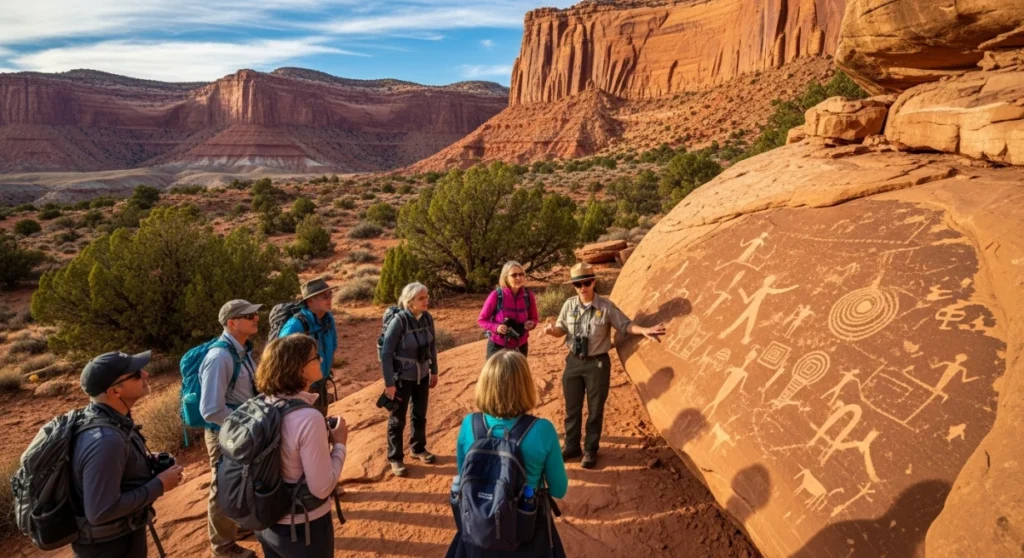
Most Capitol Reef rock art “translations” are modern guesses. Focus on observable details, accept uncertainty, avoid touching the panels, and choose guides who clearly separate facts from speculation.
Visitors step off the boardwalk below Capitol Reef’s sandstone cliffs, zoom in on a petroglyph, and the first thing someone whispers is, “That one is clearly an alien.” The second is usually, “Our guide said these are definitely hunting scenes.” Both feel satisfying. Neither is actually grounded in what we know.
This matters because the rock carvings are fragile, misunderstood, and often treated like a puzzle we are entitled to solve. When stories spread faster than facts, people get careless, touch the panels for “good luck,” or repeat myths that erase Native perspectives.
If you want your next walk along the petroglyph boardwalks to be more than a photo stop, you need a simple filter. Separate what we really know from what is guesswork, so your experience is both richer and more respectful.
What we can say for sure about Capitol Reef rock art
The carvings visible from the wooden boardwalks along Utah State Route 24 were made by people archaeologists group under the Fremont Culture, active roughly from 300 to 1300 CE. They chipped away the rock’s dark surface to expose lighter sandstone below.
Common figures include trapezoid-bodied humans, bighorn sheep, and geometric patterns. The exact meanings are not documented. Modern experts can talk about style, age, and technique, but not precise “translations” of the images.
Park infrastructure is designed to protect these panels. Two raised walkways with viewing platforms let visitors see the carvings without stepping on delicate soil or touching the rock. Even a light handprint leaves skin oils that speed up damage.
Myth vs fact: the big misunderstandings on guided walks
| Topic | Common Myth | What Evidence Supports |
|---|---|---|
| Who created the carvings | They were made by “ancient aliens” or a lost civilization. | They match known Fremont Culture styles from about 300–1300 CE. |
| Exact meaning | Each figure has a clear, single meaning we can decode. | Meanings are not recorded, so interpretations are educated guesses. |
| How to show respect | Touching the rock “to connect” is fine if hands are clean. | Oils from skin speed deterioration, so no contact is advised. |
| Best viewing method | Climbing closer gives the “real” experience. | Boardwalks are placed for safe viewing that protects the site. |
Why these myths appear on tours
Guides and visitors both want stories with clear answers. Saying “we do not know” can feel unsatisfying when a group expects a neat explanation. It is easier to label a panel as a “hunting scene” than to sit with uncertainty.
Pop culture adds fuel. TV shows and social media posts lean into dramatic claims about aliens or secret codes. When a visitor has seen that storyline before they arrive, it is natural to repeat it on the trail.
Even well intentioned guides sometimes repeat old theories that sounded convincing years ago but are now seen as oversimplified. Without regular updates from current research, those hand-me-down interpretations stay in circulation.
What research and on-the-ground practice show instead
Archaeological work links Capitol Reef’s carvings to the Fremont Tradition through tool marks, style, and dating of nearby sites from the same period. The figures belong to a recognizable regional pattern rather than a mystery civilization.
Experts emphasize how limited our insight is into the artists’ minds. We can note that trapezoid human forms and bighorn sheep appear often, and that geometric shapes may be symbolic, but no written records confirm specific “translations.”
On the management side, park staff see the physical impact of visitor behavior. Touch marks, chalking, and attempts to trace carvings leave visible scars. That is why raised boardwalks, railings, and distance viewing are now standard practice.
Responsible interpretation treats the images as meaningful expressions of past people, while acknowledging that many details of their intent will always remain unknown.
How to enjoy the panels without relying on myths
- Shift your goal: Instead of trying to solve what each figure “means,” focus on noticing patterns, tool marks, and composition.
- Listen for language: When someone says “this definitely represents…,” treat it as a hypothesis, not a fact.
- Ask for sources: If a guide shares a specific meaning, ask how we know that and whether it is a modern interpretation or tied to a living tradition.
- Use the distance: Embrace the boardwalk view. Bring small binoculars to study detail without any need to touch.
You found a hidden promo code!
Use code WOWBLOG at checkout and get 10% OFF any tour!
Limited time offer. Book now and save!
Browse ToursCommon rock art myths you will hear on Capitol Reef walks
Myth 1: “These petroglyphs are a universal storybook we can read”
Visitors often expect rock art to work like a graphic novel, with each figure mapping directly onto a modern concept. That expectation encourages very confident, very shaky translations.
In reality, symbolism is culturally specific. Even if a figure looks like a “hunter” to you, that does not mean it held that exact meaning for Fremont people, whose worldview, rituals, and daily life differed from ours.
Fact: we see motifs, not a dictionary
Across the panels you will notice recurring shapes: trapezoid bodies, horned figures, animals, and abstract designs. The repetition tells us these symbols mattered, but not precisely how.
On a good walk, a guide will help you slow down. Instead of skipping from one “caption” to the next, you compare panels, look at how figures are grouped, and consider that one image could hold many layers of meaning.
Myth 2: “If a guide says it, it must be historically proven”
People often assume every guiding comment is based on firm evidence. That is rarely true for rock art. Even with training, guides are dealing with limited data.
Some work primarily from park handouts, older interpretive texts, or popular books. Those can be useful, but they sometimes present early theories that current research treats more cautiously.
Fact: good guides label interpretations as possibilities
Experienced guides distinguish between three levels of information. First, observable facts, such as style and location. Second, widely accepted but still interpretive ideas. Third, informed speculation or personal perspective.
That clarity lets you decide what to treat as solid and where to keep an open mind. It also models intellectual honesty, which is crucial when talking about past cultures whose descendants are still here.
Myth 3: “Touching the rock is harmless if you are careful”
You will sometimes hear a visitor suggest a quick touch to “feel the history.” Others might reassure them it is fine as long as they are gentle. The effect seems tiny in the moment.
Yet rock surfaces are more vulnerable than they appear. Oils from skin darken the rock and change how it weathers. Multiplied by thousands of visitors per year, those “tiny” contacts become a real problem.
Fact: even light contact speeds deterioration
Conservation specialists consistently advise against touching petroglyphs. The safest option is distance viewing from the boardwalk. This is why railings and platforms exist along the main Capitol Reef panels.
Photography and observation do not wear down the surface in the same way. When people keep their hands off the rock, the carvings stay visible longer for everyone, including future generations.
Why rock art myths feel so attractive on a walk
Clear stories are easier to remember than careful uncertainty. A simple line like “That tall figure is the shaman, those are hunters, those are enemies” sticks in your mind and feels satisfying as you head back to the van.
Group dynamics add pressure. If one participant or guide tells a confident story, others often echo it rather than challenge it. Nobody wants to be the person slowing down the walk with “We might not know that.”
There is also a desire for personal connection. Myths about “universal symbols” suggest that we can understand the past on our terms, instead of accepting that some meanings belonged to a different culture with its own logic.
What practice actually shows works better
Groups that embrace questions over answers usually have a deeper experience. When a guide says, “Here are three possible interpretations,” people start looking more carefully and noticing fresh details on their own.
Respectful tours emphasize observable features. They talk about how the Fremont people lived in this region, what materials they used, and how the landscape around the panels might have looked centuries ago.
This approach still tells a compelling story. It just keeps clear boundaries between physical evidence and modern imagination.
Planning a Capitol Reef rock art visit as part of a broader Utah trip
Many travelers bundle Capitol Reef with other parks in the region. Instead of driving every mile on your own, you can use structured itineraries that explore several parks from a base in Salt Lake City, with transport, scenic drives, and short hikes handled by a guide.
If you are considering a wider circuit, small group tours Utah national parks style are a good match for visitors who want context without dealing with parking, navigation, and daily route planning in unfamiliar terrain.
| Option | Main Benefit | Main Drawback |
|---|---|---|
| Self-drive road trip | Maximum flexibility on timing and stops. | You handle all logistics, driving, and research yourself. |
| Guided multi-park tour | Transport, timing, and key viewpoints organized for you. | Less spontaneous schedule, small group dynamics. |
For visitors starting their journey in the city, Utah National Parks Tours offered by MateiTravel provide structured access to multiple parks in a limited number of days. You get scenic routes, photo stops, light hikes, and commentary about geology and history along the way.
How to choose a rock art–savvy guide at Capitol Reef
Not every guide has the same depth of training around archaeology and Native history. A little preparation helps you find someone who treats the petroglyphs with care, especially if you are looking for rock art and Native history guided walks in Capitol Reef with tribal guide participation or collaboration.
- Check their focus: Look for tours that specifically mention cultural or historical interpretation, not just photo stops.
- Ask about training: Before booking, ask how they stay updated about current understanding of Fremont sites.
- Listen for humility: On the walk, notice whether they clearly say “we do not know” when appropriate.
- Observe behavior: Guides should model no-touch behavior and encourage visitors to stay on established walkways.
Self-check: is your tour giving you myths or facts?
During the walk, you can quietly evaluate the information you are hearing. This quick checklist keeps you focused.
- Are you hearing sources? Factual statements are often paired with “archaeologists think” or “park research suggests.”
- Is uncertainty allowed? If every image gets a confident “translation,” that is a red flag.
- Is behavior respectful? A good guide never encourages touching, climbing, or leaving the boardwalk.
Four practical things to do instead of repeating myths
1. Use a “three levels” lens on every statement
When someone explains a figure, mentally label it as one of three levels. Level 1 is observable fact, such as “We see a trapezoid-bodied figure.” Level 2 is commonly accepted interpretation, like “Many people think this may depict a human.” Level 3 is speculation, such as “Maybe this was a spiritual leader or storyteller.”
This quick filter keeps you curious instead of blindly convinced. You can enjoy possible stories without mistaking them for proven history.
2. Prepare one or two good questions before the tour
Write down a couple of questions that invite nuance. For example: “How do archaeologists date these panels?” or “Which parts of your interpretation come from physical evidence versus modern ideas?”
Thoughtful questions encourage guides to share more about limits and methods, not just headlines. They also signal that you value accuracy over drama.
3. Build in time to linger at the boardwalks
Many groups rush past the wooden platforms along State Route 24. Plan your schedule so you can spend a few extra minutes here, even if it means one less roadside photo elsewhere.
Use that time to notice line quality, weathering, and the relationship between figures and natural rock features. The more you actually see, the less you feel a need for tidy myths.
4. Match your wider itinerary to your energy and curiosity
If you are folding Capitol Reef into a broader circuit such as Utah national parks tours from Salt Lake City, think honestly about your attention span. Too many parks in too few days can leave you skimming every site.
A realistic schedule lets you arrive at the petroglyph boardwalks not just as another quick stop, but as a highlight where you are ready to slow down and pay attention.

Example scenarios: the same panels, two very different experiences
Scenario 1: the rushed checklist stop
A group arrives late in the day after a long drive. The guide points to two panels, labels one “a hunting scene” and the other “a religious ceremony,” then checks the time and moves everyone back to the van.
Visitors leave with two photos and a vague storyline. They touched the railing, some leaned over to get closer, and the carvings blurred into all the other quick stops of the day.
Scenario 2: the curious small-group visit
A small party arrives with an extra fifteen minutes built into their schedule. Their guide explains what is firmly known about the Fremont people, then invites the group to notice patterns rather than guessing meanings.
They stay on the boardwalk, use binoculars to study detail, and discuss several possible interpretations without claiming certainty. Everyone leaves with more questions, more respect, and a clearer sense of how fragile these panels are.
Key pros and cons of focusing on rock art during your Utah trip
| Aspect | Pros | Cons |
|---|---|---|
| Time spent at panels | Deeper understanding of local history and culture. | Less time available for longer hikes or distant viewpoints. |
| Guided interpretation | Context about Fremont Culture and park geology. | Quality varies by guide, some repeat outdated myths. |
| Distance viewing | Protects the rock, safe for everyone. | Requires patience, detail is not as dramatic as close contact. |
Practical tips for a meaningful and respectful visit
- Bring simple tools: A small pair of binoculars or a zoom-capable camera makes the boardwalk distance feel close rather than limiting.
- Visit at softer light times: Early morning or late afternoon often makes carvings easier to see because of side lighting on the rock.
- Read park materials first: Skim the official information about Fremont petroglyphs before your walk so you can tell when comments align with established facts.
- Set expectations with kids: Explain before you arrive that nobody will touch the rock and that the goal is to observe, not to climb.
- Balance your day: Pair the quiet focus of the boardwalks with a short hike or scenic drive so the whole group stays engaged.
Conclusion
The rock carvings at Capitol Reef offer a rare window into the region’s deep human past, yet much of what gets said about them on tours is more story than evidence. Recognizing the difference helps you avoid casual myths and the disrespectful behavior that often comes with them.
Focus on what is actually known about Fremont Culture, be honest about open questions, and treat every confident “translation” as a possibility rather than a guarantee. Simple practices like staying on the boardwalk, using binoculars, and asking thoughtful questions can transform a quick stop into a genuinely memorable encounter with the site.
When you fold Capitol Reef into a wider journey with MateiTravel or another operator, choose itineraries and guides who treat rock art as living heritage, not just a backdrop.
If you want logistics handled so you can focus on learning and looking, consider a small-group itinerary that prioritizes time and context over sheer park count.
Can we know for sure what the Capitol Reef petroglyphs mean?
No. Experts can link them to the Fremont Culture and note recurring motifs, but there are no written records that confirm precise meanings.
Why are visitors asked not to touch the rock art panels?
Oils from human skin darken the surface and speed up weathering. Even very light contact, repeated over time, causes visible damage.
Where can I see the petroglyphs in Capitol Reef without hiking far?
Two wooden boardwalks with viewing platforms along Utah State Route 24 offer easy access and good views of the main panels.
How can I tell if my guide is being careful with interpretations?
Look for guides who separate observable facts from theories, clearly say when something is uncertain, and welcome questions about their sources.
What should I bring to see the carvings more clearly from the boardwalk?
A compact pair of binoculars or a camera with a decent zoom lets you appreciate fine details without getting closer to the rock.
Is it better to visit Capitol Reef rock art on my own or with a group tour?
Independent visits offer flexibility, while a good small group tour can provide context, transport, and a clear schedule that reduces planning stress.
How much time should I plan for the rock art boardwalks?
Plan at least 20 to 40 minutes so you can walk both platforms, study several panels carefully, and take photos without rushing.
Can children visit the petroglyph boardwalks safely?
Yes. The raised walkways and railings make it family friendly, as long as adults explain why everyone must stay on the path and not touch the rock.

 Bonneville Salt Flats – Sunset Adventure of the White Desert
 Antelope Island – Wild Heart of the Great Salt Lake Adventure
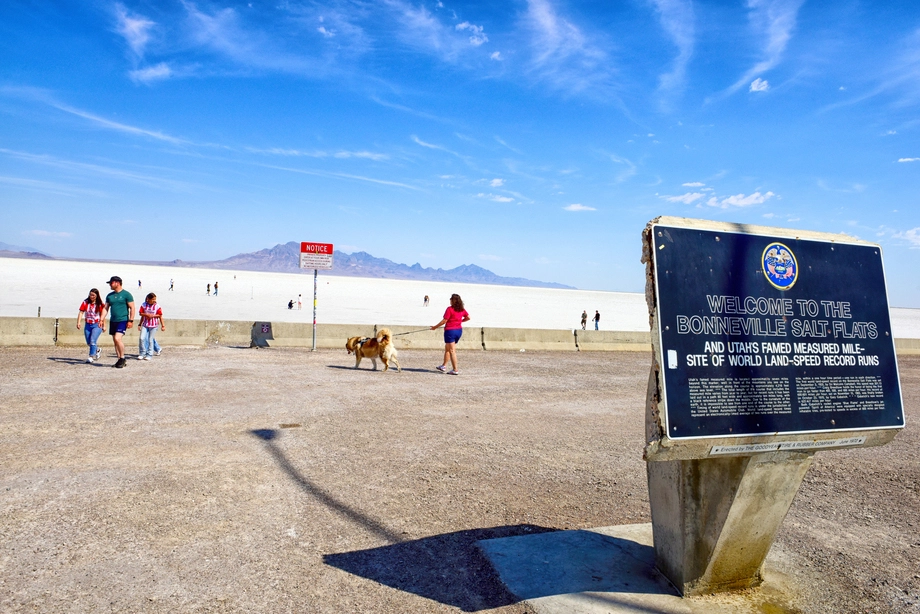 Bonneville Salt Flats – Journey to the Edge of the World
 Salt Lake City – The City of Zion. Historical Interactive Walking Tour
 Antelope Island Sunset Wildlife Expedition – Great Salt Lake Odyssey